AI inference hardware is becoming a system-design problem, not a race to buy the accelerator with the highest quoted throughput. Modern serving workloads move tokens through a chain: request admission, KV-cache lookup, memory reads, attention, networking, batching, tool calls, and response streaming. A fast GPU can still spend time idle or underfed when any part of that chain stalls. That is why infrastructure teams should treat the rack, fabric, memory hierarchy, and scheduler as one product.
Why AI inference hardware is not the whole system
Inference has two different performance stories. Prefill processes the prompt and usually favors large matrix work. Decode generates tokens one at a time, repeatedly reading the model weights and the growing KV cache. A benchmark that reports only aggregate tokens per second can hide the part a user feels: time to first token, then the pauses between tokens when queues, cache misses, or network transfers appear.
Blackwell Ultra illustrates the scale of the memory side. NVIDIA states that its GPU carries 288 GB of HBM3e and 8 TB/s of memory bandwidth. It also describes 1.8 TB/s of bidirectional NVLink 5 bandwidth, with a non-blocking fabric up to 576 GPUs. Those are hardware figures, not a promise of application throughput. They do show why a single-GPU specification no longer explains a serving cluster. Model placement, parallelism, and the path between accelerators determine whether the advertised bandwidth reaches a real request.
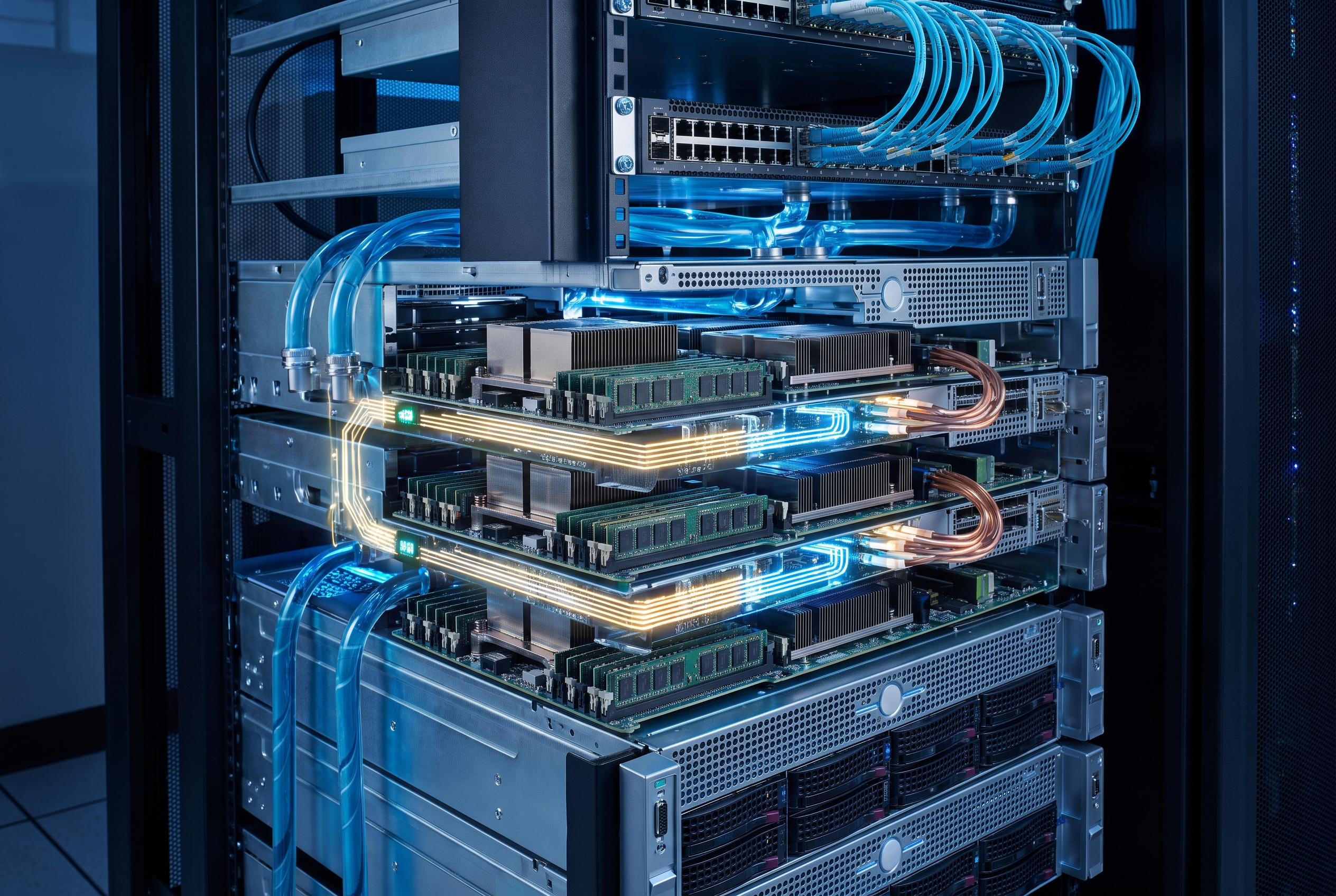
There is a simple operational consequence. An accelerator fleet can look healthy at the host level while the service misses its latency objective. GPU utilization alone cannot distinguish useful work from time lost waiting for a remote cache shard, a congested link, or a batch held for the next request. Teams need request-level traces alongside accelerator telemetry.
Memory and context are now first class
Long prompts and multi-turn agents make the KV cache a capacity plan, not an implementation detail. The cache stores attention state for prior tokens so the model does not recompute it on every decode step. Its footprint rises with sequence length, layers, hidden size, precision, and concurrent sessions. When it fits locally, decode can stay near the accelerator. When it does not, the service must evict, recompute, or fetch state across a slower tier.
That is why the new platform roadmaps talk about context explicitly. NVIDIA’s January 2026 Rubin announcement describes an Inference Context Memory Storage Platform paired with BlueField-4. The announcement also groups the Vera CPU, Rubin GPU, NVLink 6 switch, ConnectX-9 SuperNIC, BlueField-4 DPU, and Spectrum-6 Ethernet into one design. The precise product claims need independent production validation, but the architecture signal is clear: vendors now see retained context and data movement as part of the inference path.
For developers, this changes API and product choices. A 200,000-token context limit does not mean every request should carry 200,000 tokens. Cache stable system instructions and document prefixes. Retrieve narrow chunks instead of sending an entire corpus. Keep session affinity when it improves cache reuse. Summarize old turns before they become expensive history. These habits lower memory pressure before an infrastructure purchase is even considered.
Networking shapes tail latency
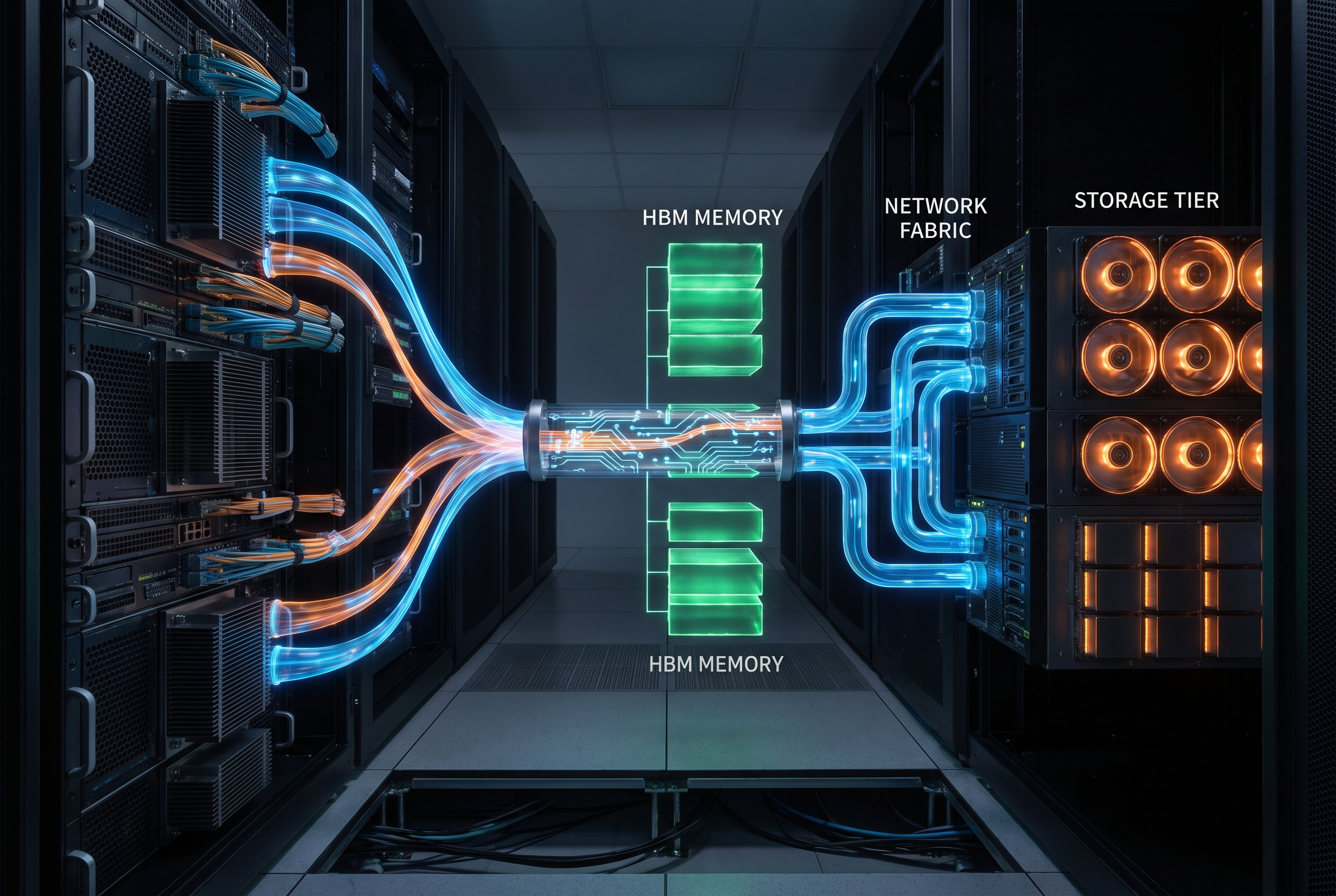
Tensor parallel and expert parallel deployments exchange activations or routing traffic during a request. That makes network latency and congestion part of token latency. A fabric can have high headline bandwidth but still produce poor p95 or p99 response times if many replicas synchronize at once, routing spreads experts unevenly, or background cache traffic competes with inference traffic.
The remedy is not to assume every model needs the largest possible fabric. First map the model and serving engine. Measure the message sizes, collectives, bytes per generated token, and the number of accelerator boundaries crossed. Then compare a local single-node deployment, a tightly coupled rack-scale deployment, and a routed multi-node deployment using the same traffic mix. The winning design often depends on the workload: a short classification request, a retrieval answer, and a tool-using agent have different bottlenecks.
Cooling and power belong in that same discussion. More dense compute can reduce the number of servers, yet it may increase rack power density and change liquid-cooling, redundancy, and maintenance requirements. A capacity plan that stops at GPU count misses the limits imposed by power delivery, thermal headroom, switch ports, and spare capacity during failures.
How to evaluate AI inference hardware
Build an evaluation around representative requests, not a single synthetic prompt. Include a short chat turn, a retrieval-heavy request, a long-context conversation, a tool call, and a burst of concurrent sessions. Run each with the batching, quantization, routing, and safety settings planned for production. Record the following numbers for every case:
- Time to first token, p50, p95, and p99.
- Inter-token latency and completed requests per second.
- Prompt tokens, generated tokens, and tokens per joule.
- KV-cache hit rate, eviction rate, and recompute work.
- Queue time, batch size, accelerator memory use, and network utilization.
- Error rate and recovery time during a host, link, or replica failure.
Keep the data separated by model, context band, and request type. An average across all prompts can make a system look better than it feels to the customers with the longest conversations. Also test at the concurrency expected after launch. A system that looks quick at eight requests may queue badly at 80.
For context on the component tradeoffs, see NVIDIA’s Blackwell Ultra technical overview and its Rubin platform announcement. Both are vendor sources, so use them for architecture and stated specifications, then validate application performance with the exact model and software stack being deployed.
Practical decisions for platform teams
Start with a service-level objective. If the product needs a first token in under one second, make that a hard test rather than an aspiration. Route routine work to a smaller model when it passes quality checks. Reserve larger models and long contexts for tasks that earn their cost. Set per-tenant token limits and backpressure before a traffic spike forces the decision.
Next, make cache behavior observable. Attribute misses to a request class, a deployment change, or an eviction policy. A rising cache miss rate may point to poor session routing rather than insufficient compute. Treat model updates as infrastructure changes too: a new tokenizer, longer default prompt, or different parallelism plan can shift memory and network demand overnight.
Finally, buy and operate AI inference hardware as a service chain. Accelerators matter. So do the memory tier, fabric, scheduler, cooling loop, and the application choices that decide how much context enters the system. The teams that measure that chain end to end will make better capacity calls than teams comparing a single FLOPS number. Run and scale models with Wiro.