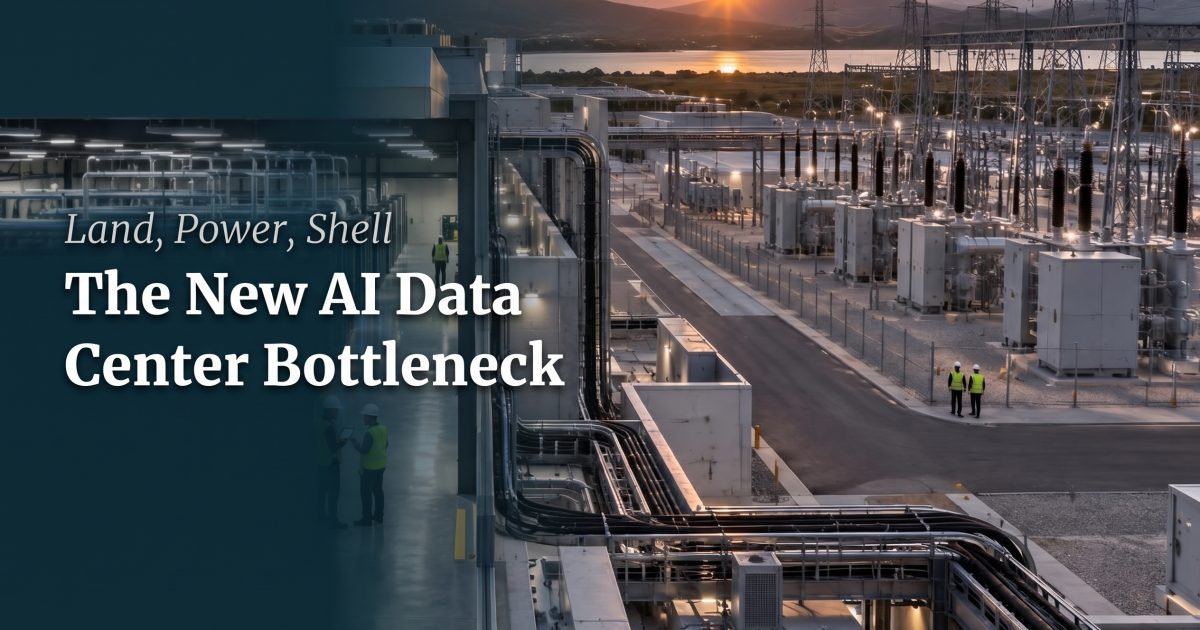
Land power shell has become a hard constraint for AI data center capacity. Buying accelerators is not enough when a site lacks a deliverable interconnect, a completed building shell, a cooling plant, a network path, and a power schedule that matches deployment. NVIDIA’s August announcement around the PORTS-Pike campus makes the shift plain: it secured capacity for an initial 4.25 IT-GW deployment, while OpenAI agreed to take 8 IT-GW at the site.
Why land power shell decides AI data center capacity
A GPU order has a lead time. A usable campus has several interlocking ones. Transmission upgrades, substation transformers, permits, site grading, structural work, switchgear, chillers, backup generation, and fiber can each set the completion date. The slowest dependency decides when a cluster can produce tokens.
That makes accelerator count an incomplete planning metric. A better question is: how many IT megawatts can be energized, cooled, networked, commissioned, and accepted by a workload on a named date? The answer needs utility milestones, equipment delivery dates, construction progress, and an operating plan. It cannot come from a GPU purchase order alone.
The scale behind the question is changing fast. The International Energy Agency projects that global data-center electricity use will reach about 945 TWh in 2030 in its base case, more than double its 2024 level. AI does not explain every new megawatt, but it changes the shape of demand: large blocks of dense, round-the-clock load appear in a few constrained regions.
At PORTS-Pike, the first 800 MW are expected in 2028 using much of the existing AEP infrastructure, according to OpenAI’s project update. The rest depends on new transmission, generation, and associated infrastructure. That distinction matters. Announced capacity, contracted capacity, and energizable capacity are different numbers. Treating them as interchangeable creates bad delivery forecasts.
Land power shell: power is a delivery problem
Power has to cross several boundaries before it reaches an AI rack. Generation and transmission feed a grid interconnect. A substation steps voltage down. Medium-voltage distribution reaches the building. Transformers, switchgear, UPS systems, busways, and power distribution units deliver electricity to servers. Each handoff carries capacity limits, loss, protection settings, procurement risk, and a commissioning sequence.
For infrastructure teams, the useful measure is not just utility service size. It is the IT load that remains after cooling, pumps, fans, lighting, power conversion, and other facility overhead. If a hall has a power usage effectiveness of 1.2, every 100 MW of IT load needs roughly 120 MW at the facility boundary. A 4.25 IT-GW deployment therefore implies materially more upstream power than 4.25 GW. The exact figure depends on the final electrical and cooling design.
Rack density makes the problem sharper. Conventional enterprise rooms often planned around single-digit kilowatts per rack. Dense GPU systems can push far beyond that, which forces teams to reconsider busway ratings, transformer placement, floor loading, cable paths, and heat removal. A shell that can hold racks is not automatically a shell that can support high-density AI racks.
Two visuals for capacity planning
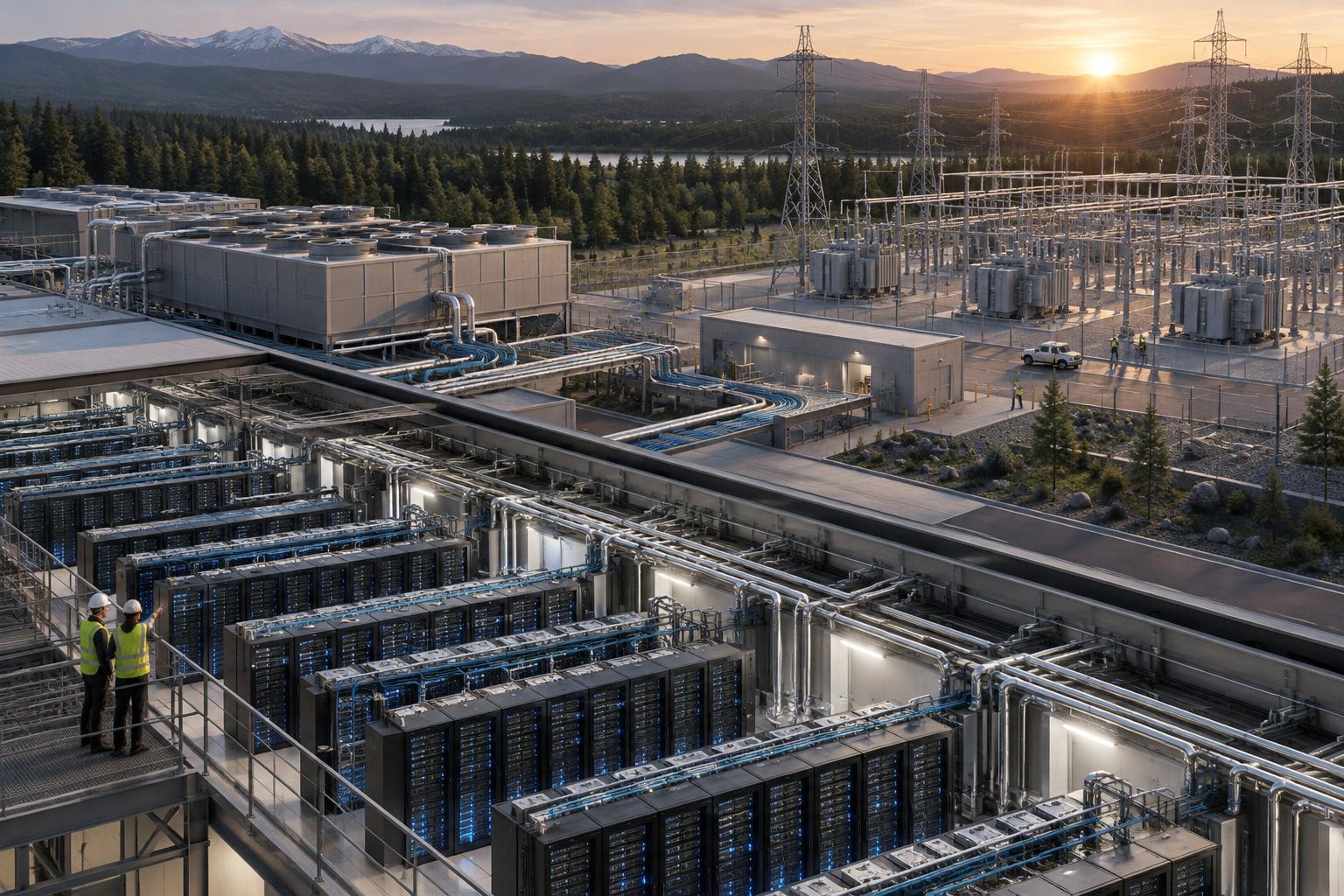
The first visual puts compute halls beside the transformer yard. That adjacency is the point. Compute density depends on the path from generation and grid interconnect through transformers, distribution, and rack-level delivery. Cooling belongs on the same planning board because the thermal system draws power and determines how much heat can leave the room.
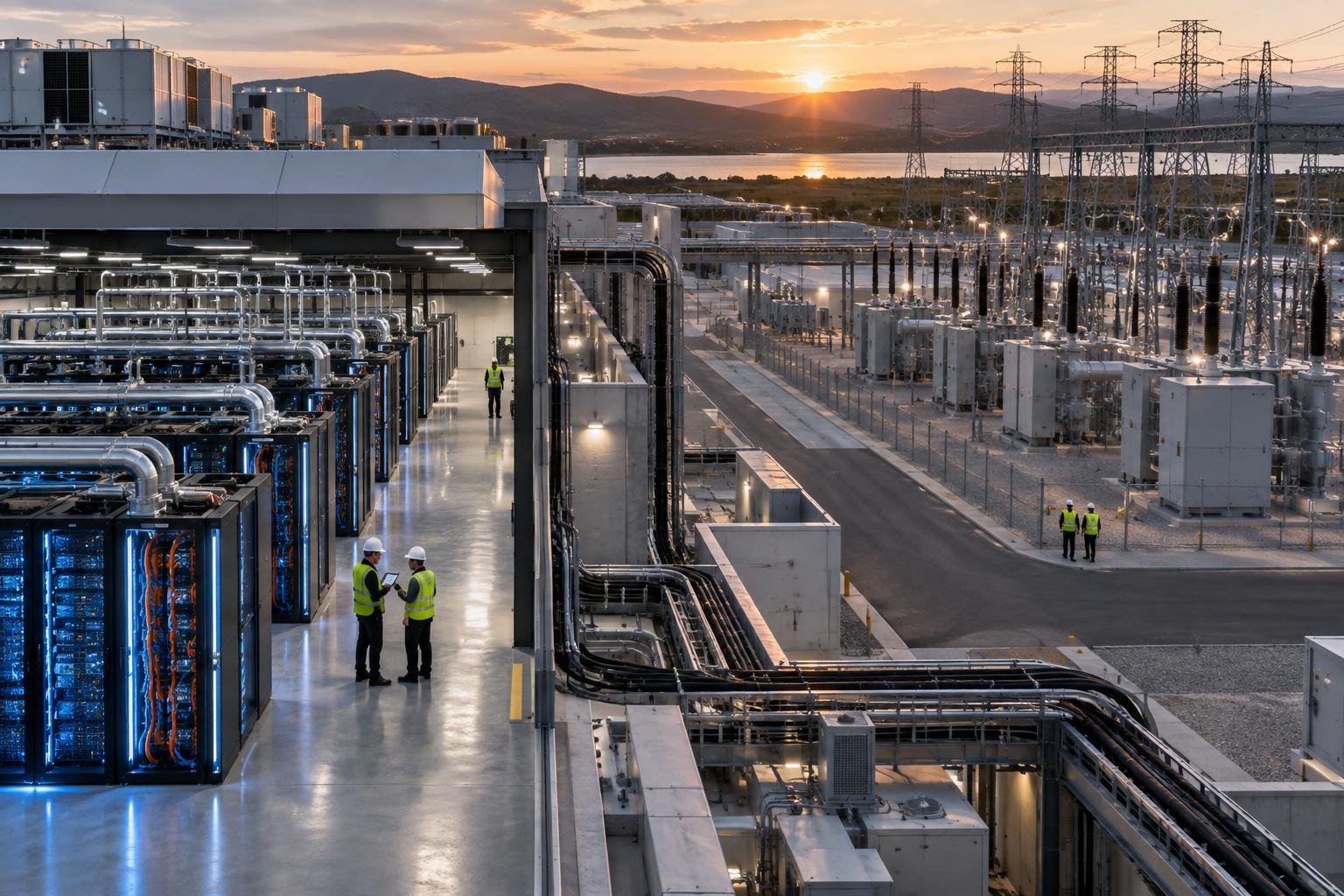
The second visual adds liquid cooling and fiber. Training clusters and large inference fleets stress electrical delivery, heat rejection, and east-west network traffic at the same time. A campus that runs those as independent workstreams tends to find integration faults late, when remediation is expensive and schedule slack has disappeared.
Cooling changes the shell
Air cooling remains useful, but high-density GPU deployments increasingly need direct-to-chip liquid cooling or another liquid-assisted design. That changes mechanical space, piping routes, leak detection, water treatment, heat-exchanger capacity, controls, and maintenance procedures. It also changes the boundary between the IT and facilities teams. A server rollout and a cooling rollout now have to pass acceptance testing together.
Water claims need the same discipline as power claims. OpenAI says PORTS-Pike intends to use closed-loop, air-cooled systems that recirculate water rather than cooling towers with ongoing evaporative demand. That may reduce continuous water use, but teams still need a site-specific answer on fill volume, heat rejection under peak conditions, and the maintenance plan. The design details matter more than a generic label.
What changes in AI infrastructure procurement
NVIDIA says its arrangement includes credit support for land, power, and shell buildout, while SB Energy will build, own, and operate the facility under a 20-year lease to OpenAI. NVIDIA also says it will invest $1.5 billion in SB Energy. The lesson is not that every buyer needs a gigawatt deal. It is that compute buyers are moving upstream and reserving physical prerequisites instead of waiting for a finished data hall.
For smaller operators, land power shell should become a product dependency in the capacity plan. Ask a colocation provider for contracted power, deliverable power, the interconnection queue position, upgrade milestones, cooling allocation, generator assumptions, and available cross-connect capacity. Ask a cloud provider which limits are regional, which are quota controls, and which reflect temporary queue pressure. Put those answers next to the model demand forecast.
Developers should translate facility uncertainty into application choices. Keep a portable deployment target for burst demand. Separate latency-sensitive inference from batch work. Measure tokens per second, tail latency, and queue time by region. Make the deployment pipeline able to drain or redirect work when a zone hits a power, cooling, or network limit. A failover plan that only checks whether a facility is online misses the workload impact.
Phased builds need phased commitments. Reserve an early block for validated demand, then attach later options to construction and energization gates. The PORTS-Pike announcement describes capacity coming online in phases beginning in 2028, not as one finished 8-GW switch. Planning capacity in stages protects teams from paying for idle space while preserving a route to scale.
Land power shell checklist for technical buyers
- Separate announced power, contracted power, and deliverable IT load in every forecast.
- Map utility milestones beside GPU delivery, network turn-up, cooling completion, and workload commissioning dates.
- Model PUE, cooling, water, backup power, and network fabric as capacity inputs, not later facilities work.
- Ask for substation, transformer, switchgear, and generator lead times before committing to an availability date.
- Test failover at the application layer with realistic model traffic and regional quotas.
- Use staged reservations tied to energization gates and measured utilization.
Land, power, and shell are no longer background details in an AI infrastructure plan. They set the boundary for how quickly hardware turns into available inference and training capacity. Teams that track that boundary early can make better calls on region selection, deployment design, and committed spend. Run and scale models across infrastructure you can observe and control on Wiro.