
AI infrastructure systems are replacing the standalone GPU as the unit of design. NVIDIA’s Vera Rubin platform makes that shift unusually visible: seven chips and five rack-scale systems divide the work of training, context handling, low-latency generation, agent execution, storage, and networking. The GPU still matters, but a GPU alone no longer explains whether an AI service is fast, economical, or dependable.
The original framing called Rubin a six-chip system. NVIDIA’s March 2026 platform announcement lists seven: Vera CPU, Rubin GPU, NVLink 6 Switch, ConnectX-9 SuperNIC, BlueField-4 DPU, Spectrum-6 Ethernet switch, and the integrated Groq 3 LPU. That correction matters because the missing component changes the central lesson. This is not a faster accelerator attached to familiar servers. It is an attempt to make an entire pod behave like one computer.
AI infrastructure systems need more than accelerator FLOPS
Rubin’s compute rack, the Vera Rubin NVL72, combines 72 Rubin GPUs with 36 Vera CPUs and a sixth-generation NVLink copper spine. NVIDIA says the rack can deliver up to four times the training performance and up to ten times the inference performance per watt of Blackwell, with a claimed one-tenth token cost. Those are vendor claims, not a capacity plan. Still, the numbers show what NVIDIA is optimizing: completed work per watt and per token, rather than a headline figure for one chip.
Each of the seven parts addresses a different bottleneck. Rubin GPUs execute dense tensor work and hold model weights in high-bandwidth memory. Vera CPUs run the control-plane work that GPUs handle poorly: scheduling, tool execution, sandboxed environments, data preparation, and reinforcement learning rollouts. NVLink 6 and its switch create the scale-up fabric so GPUs can exchange activations and expert routing traffic without falling back to a conventional network path.
ConnectX-9 SuperNICs move traffic between nodes. BlueField-4 DPUs offload infrastructure duties such as storage and network processing. Spectrum-6 Ethernet connects systems at scale. The Groq 3 LPU adds a separate low-latency inference path, built around SRAM rather than large HBM pools. NVIDIA says an LPX rack uses 256 LPUs, 128GB of on-chip SRAM, and 640TB/s of scale-up bandwidth. That is a different answer to the decode-phase problem: return the next token quickly while the GPU fleet remains busy with larger batches and context-heavy work.
This separation tracks the shape of modern AI workloads. Prefill processes a prompt and its context; decode generates token after token. A short chatbot request may spend little time in prefill. An agent with a long system prompt, retrieved documents, tool traces, and a million-token context can do the opposite. The same service can also need hundreds of CPU sandboxes to run code, browse a private knowledge base, or validate a result. A benchmark that only measures GPU throughput misses those handoffs.
Why the rack is the new unit of infrastructure
NVIDIA’s technical description puts a Vera Rubin POD at 40 racks, 1,152 Rubin GPUs, nearly 20,000 NVIDIA dies, 60 exaflops, and 10PB/s of total scale-up bandwidth. The company also describes five specialized rack types: NVL72 GPU racks, Vera CPU racks, Groq 3 LPX inference racks, BlueField-4 STX storage racks, and Spectrum-6 SPX Ethernet racks. The relevant design decision happens at pod scale because a request crosses several of them before it reaches a user.
Context memory is the clearest example. During generation, the model stores attention state in a KV cache. That state can become expensive long before arithmetic is the limit. NVIDIA positions BlueField-4 STX and its CMX context-memory layer as shared storage for offloaded KV cache. The technical blog claims up to five times higher tokens per second and five times better power efficiency for that offload path. Whether a deployment reaches that figure depends on model, cache policy, network behavior, and batch mix. The architectural point survives: cache placement has become a first-order infrastructure decision.
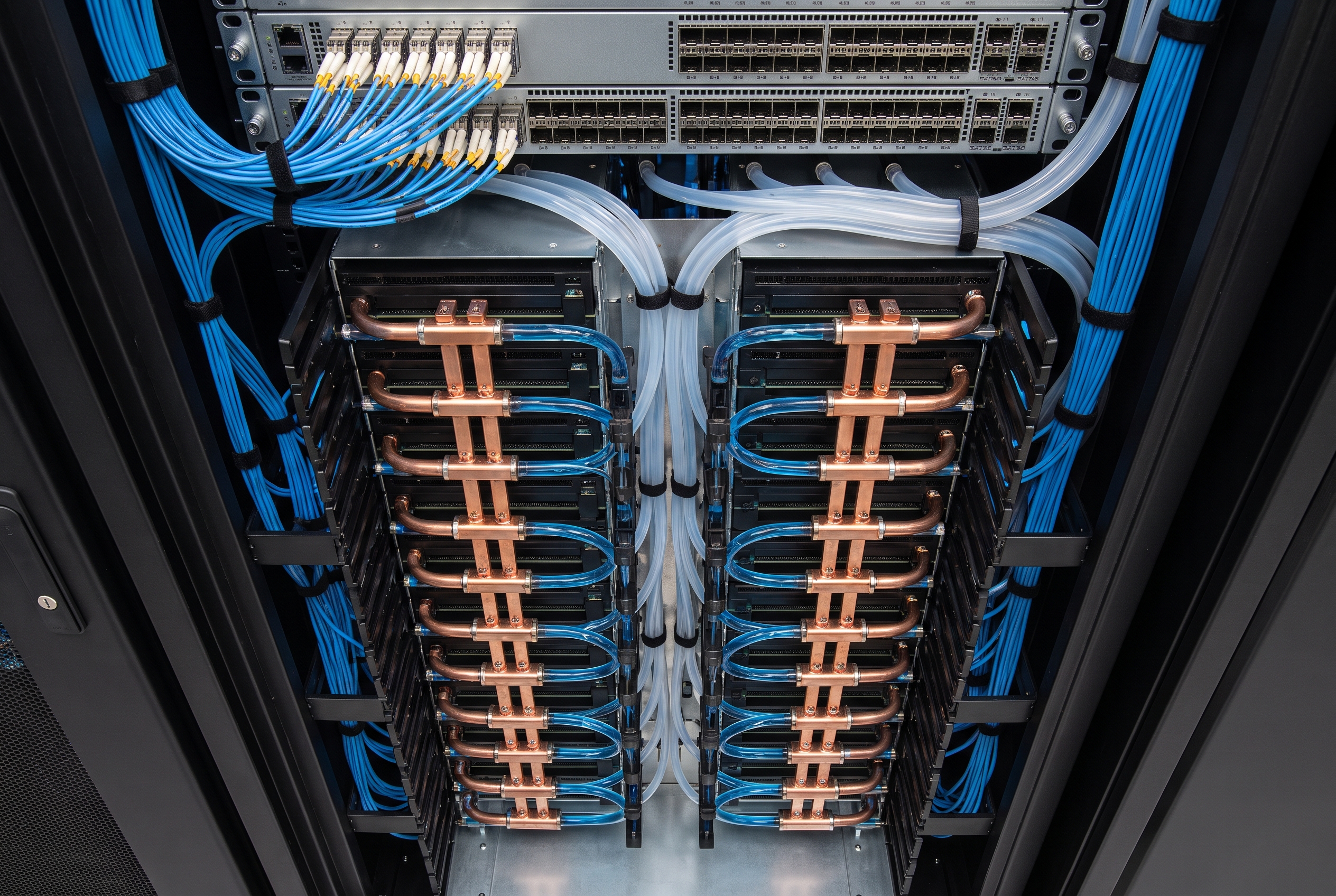
Cooling belongs in the same discussion. NVIDIA describes 45C warm-water liquid cooling and intelligent power smoothing in its third-generation MGX architecture. The practical consequence is simple. Teams cannot procure accelerator trays, power distribution, pumps, facility water, and network fabric as separate projects, then expect the system to behave predictably. Rack density and thermal headroom shape how much of the purchased compute can run at once.
NVIDIA’s Vera Rubin POD technical overview provides the full rack-level breakdown. The official platform announcement also describes the company claims around throughput, efficiency, and token cost. Those claims should be tested against a team’s own model mix, input lengths, concurrency, and service-level objectives.
What changes for developers
Developers do not need to write code for each chip. They do need to stop treating the model server as the whole application. Long-context retrieval, agent loops, structured output retries, tool calls, and safety checks create a pipeline. A slow vector-store fetch can leave expensive accelerators idle. A saturated CPU worker pool can delay tool execution even when GPU utilization looks healthy. A poor cache policy can turn a stable service into a tail-latency problem.
Measure a request as stages: queue time, prompt ingestion, first-token latency, decode throughput, tool latency, cache hit rate, retry rate, and final task completion. Break those metrics down by model, context length, batch size, tenant, and route. Median latency is useful, but p95 and p99 expose the handoffs that users notice. Token throughput alone can look excellent while time to first token is unacceptable for interactive use.

Routing also becomes more valuable. Send short, latency-sensitive prompts to a low-latency path. Batch long offline jobs where throughput matters more. Reuse stable prompt prefixes and retrieved context when policy permits. Keep CPU-backed agent environments close to the services that need them. These choices can reduce cost and improve responsiveness without changing the model weights.
A practical checklist for infrastructure teams
- Start with the request mix. Record input tokens, output tokens, context length, tool-call count, and concurrency before choosing a rack design.
- Separate prefill and decode measurements. They stress memory, compute, and network paths differently.
- Budget for KV cache explicitly. Track its memory footprint, hit rate, eviction behavior, and offload latency.
- Test the full path. Include retrieval, guardrails, CPU tools, storage, and network hops in load tests.
- Plan the facility with the pod. Validate liquid-cooling capacity, rack power, network oversubscription, and failure domains together.
- Compare completed tasks. Use cost per successful task and p95 completion time alongside tokens per second.
AI infrastructure systems will keep becoming more specialized because agentic workloads mix several kinds of work in one request. Rubin is a concrete example of that trend, not a reason to accept a vendor architecture without measurement. The durable lesson is to size the system around data movement, cache behavior, CPU orchestration, and power as seriously as the accelerator count.
Run and scale models with Wiro, then use workload-level measurements to decide where inference actually needs more compute, memory, network capacity, or operational discipline.