Meta Prometheus supercluster is not a bigger data center. It is a different operating problem. Meta says the first phase of Prometheus in New Albany, Ohio is complete, with the site now scaling toward roughly one million GPUs. At that size, racks, buildings, and accelerators matter. The harder question is how every layer behaves as one machine.
The announcement changes the useful unit of analysis for AI infrastructure. A 72-GPU rack is not the system. A hall is not the system. Even one building is not the system. The system is the path from GPU memory to the network fabric, cooling loop, power train, firmware fleet, and job scheduler. A weak link can leave expensive accelerators waiting.
Meta Prometheus supercluster turns uptime into useful compute
Meta describes Prometheus as hundreds of thousands of GPUs spread across multiple connected buildings. The company reports more than 85% goodput on pre-training runs and more than 90% on reinforcement-learning runs for Muse Wonder. It also cites a wall-clock mean time between interruptions of about 47,000 GPU hours, later improved beyond 54,000 GPU hours through fleet changes.
Those numbers point to a practical shift. Peak FLOPS only matter when a long training job stays synchronized. A host fault, a failed link, a slow collective, or a cooling excursion can interrupt work across a much larger job. At cluster scale, reliability engineering becomes capacity engineering. Every avoided interruption returns GPU time to the workload.
Prometheus also shows why component specifications must be read in context. Meta says its Catalina platform uses two racks for a 72-GPU GB200 NVL72 domain, while Clemente moves a GB300 NVL72 domain into one rack. The latter increases HBM3e capacity per GPU from 192 GB to 288 GB and places about 135 kW at the rack. That is progress in density, but it also raises the cost of every operational mistake around that rack.
The network becomes part of the computer
The central design choice is not simply more bandwidth. It is matching bandwidth, topology, and scheduling to the communication pattern of a training job. Meta says it provisioned 800G of scale-out I/O per GPU on its GB200 Ariel configuration because 400G would have created an imbalance against the larger NVLink domain. In other words, scale-up and scale-out must move together.
That choice matters beyond a single vendor platform. Large training jobs create intense local traffic inside a replica, then a different class of traffic between replicas and buildings. Treating every flow alike leaves congestion control to react after the job has already slowed. Prometheus uses a dedicated backend network for GPU-to-GPU communication, plus building fabrics and an aggregation layer between buildings.
Meta’s Prometheus engineering overview describes fabrics with virtual output queues, credit-based flow control, adaptive routing, and multipath handling. These are not decorative network features. They are workload controls. The goal is to keep collective operations from turning a few colliding flows into idle accelerators.
This is the useful lesson for smaller operators too. The cluster does not need to be a million GPUs before network behavior becomes visible in utilization. Once workloads use expert parallelism, long context, or frequent all-to-all exchanges, oversubscription and weak routing policy show up as queue time and lower throughput. The right dashboard should put job goodput, collective latency, retransmits, and GPU wait states next to GPU utilization.
Power and cooling set the deployment pace
Prometheus is also a facility story. Meta describes air-assisted liquid cooling, facility liquid cooling, high-power racks, and multi-building interconnects. Each choice changes construction sequencing. Power, cooling water, heat rejection, rack installation, and network turn-up must arrive in the same window. An available GPU without a commissioned cooling path is not capacity.
High-density systems make this coordination more severe. A rack at roughly 135 kW concentrates a large thermal load into a small operational zone. The facility must handle ordinary operation, maintenance, failover, and uneven demand without forcing the job scheduler to retreat. That is why closed-loop cooling and serviceability deserve the same design attention as accelerator count.
There is a second-order effect. Better cooling and cabling layouts reduce the time spent repairing and expanding the fleet. Meta’s move toward a single-rack 72-GPU domain reduces cabling compared with its earlier two-rack arrangement. The benefit is not only cleaner diagrams. Fewer physical dependencies make deployment and fault isolation faster.
What operators should copy from the design
Most teams cannot copy Prometheus scale. They can copy its order of operations. First, define the workload: training, batch inference, interactive inference, or agents. Second, map the dominant data movement. Third, size the network and cache hierarchy before finalizing the rack count. Fourth, design cooling, power, firmware, and maintenance around the failure budget for the job.
For inference fleets, the same discipline applies in a smaller form. Long-context requests move pressure from pure compute to HBM and KV-cache transport. Mixture-of-experts models make routing and all-to-all behavior more important. A rack that looks efficient in isolation can become costly when the network forces it to wait. Capacity planning must follow useful work per deployed system, not accelerator inventory.
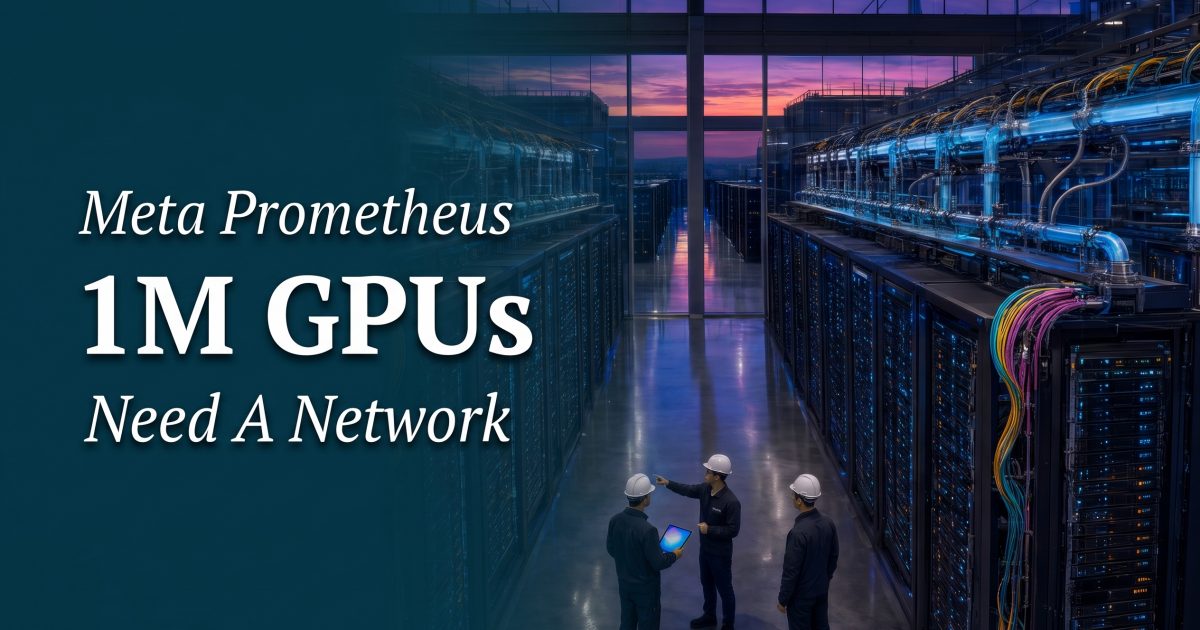
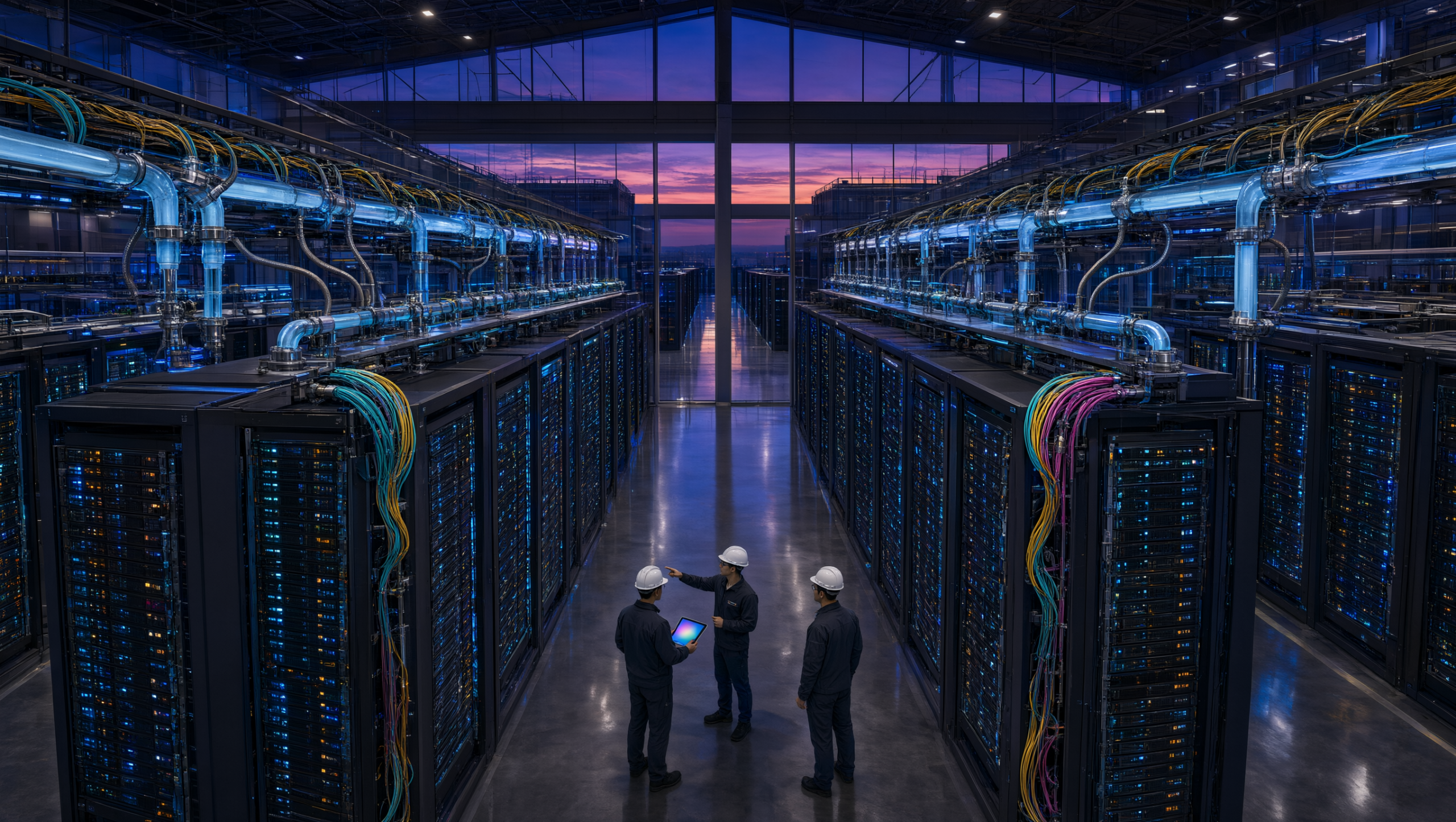
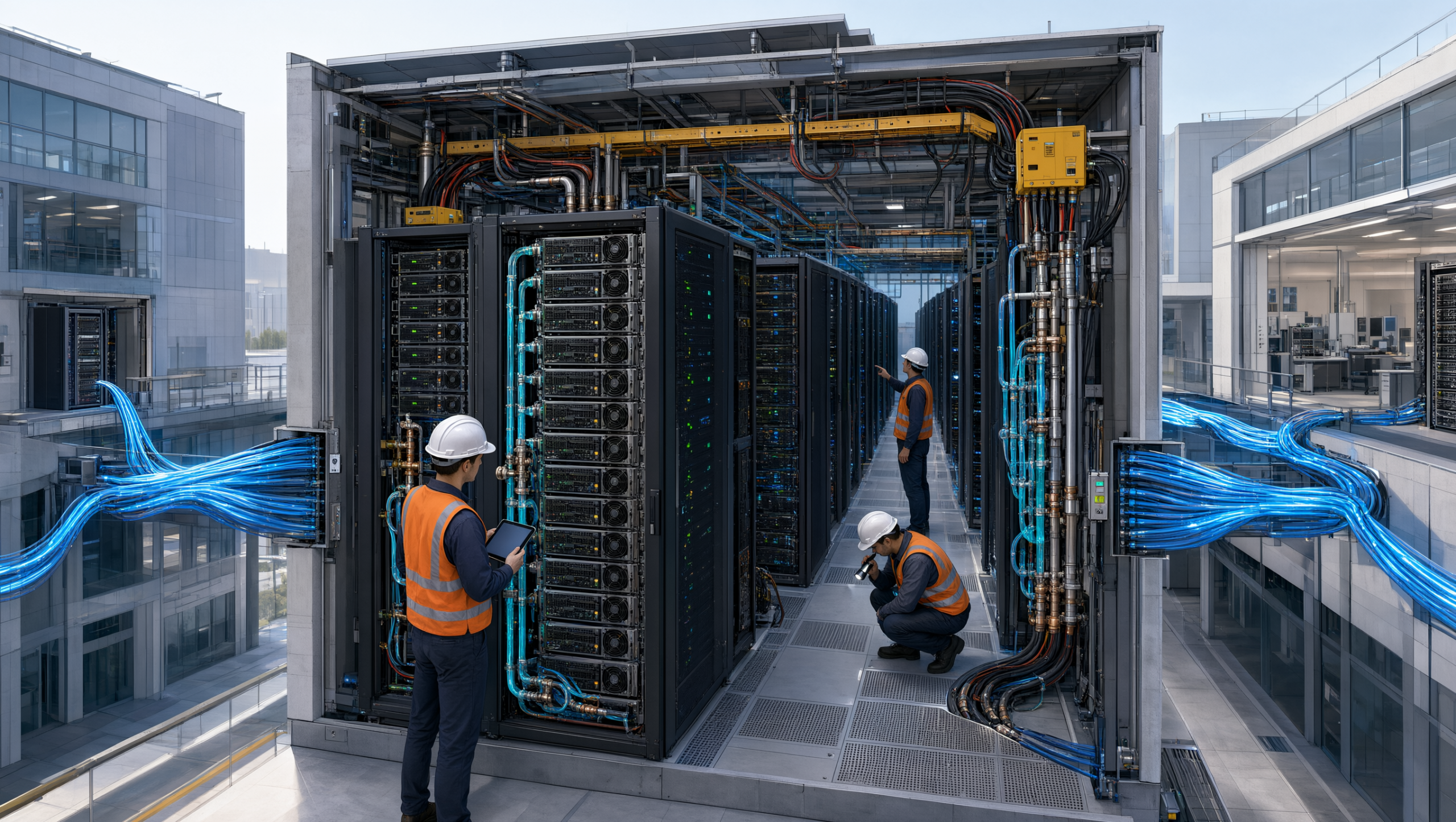
The two diagrams in this post were created with Qwen Image 3.0 Pro to illustrate the physical dependencies behind a supercluster. They are not a benchmark. The operational numbers come from Meta’s disclosure, and the infrastructure conclusion is simpler: at this scale, the network, cooling loop, and control plane are part of the accelerator.
Run and scale production models on Wiro.