
NoGPU pipelines are useful when an AI video request is really a repeatable media operation, not an open-ended generation problem. A vertical effect that accepts one portrait, applies a known transformation, encodes a fixed output, and delivers it to a CDN has a much smaller operating envelope than a text-to-video endpoint. That difference changes the queue, the observability model, and the hardware decision.
NoGPU pipelines change the serving decision
The name does not mean that video work has no compute cost. Decoding, resizing, compositing, encoding, storage, moderation, and delivery still consume resources. It means the product team should not expose a general-purpose accelerator queue for every job. The service can keep the expensive, variable model work behind a managed contract while the application deals with a small set of inputs and outputs.
That contract matters. A broad text-to-video request can vary by prompt length, requested duration, frame rate, resolution, seed behavior, reference inputs, and safety review. A single-purpose effect usually has a narrower range: one uploaded image, a fixed output ratio, a known clip length, and a prescribed delivery format. The first needs admission control and elastic accelerator capacity. The second often needs predictable orchestration more than a visible GPU reservation.
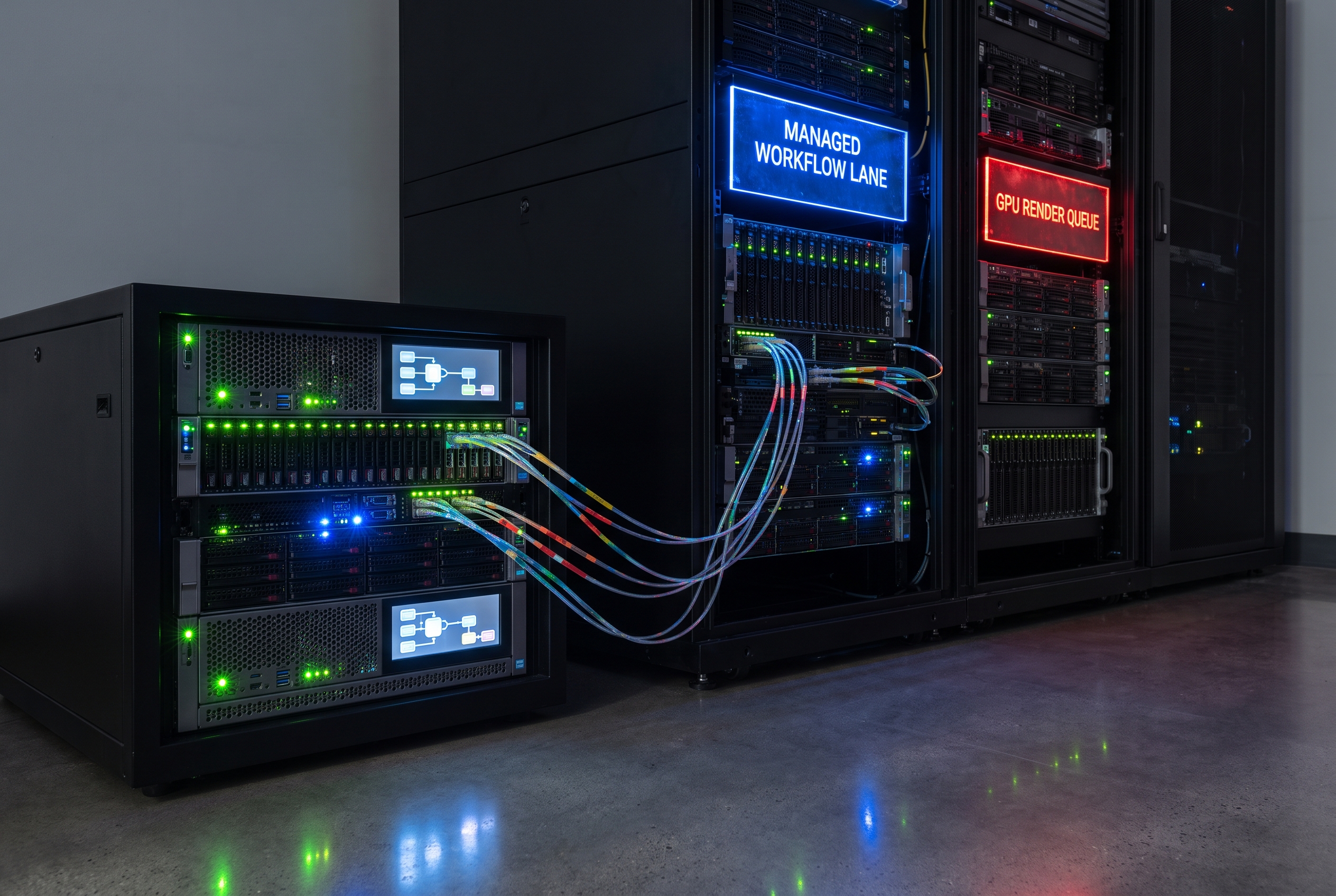
For developers, this is an API design choice. Do not label both endpoints simply as generate video. Split the request types. One endpoint can accept a constrained effect request and return a job ID with fixed validation rules. Another can accept exploratory generation settings and make its queuing behavior explicit. That distinction prevents a consumer photo effect from competing with a long creative render for the same scarce capacity.
Where the GPU queue still belongs
GPU-backed generation remains the right path when the output is open ended. Text-to-video, multi-reference animation, long clips, unusual aspect ratios, high frame counts, and iterative art direction all have uncertain execution cost. A queue protects the platform when demand spikes and gives scheduling policy somewhere to act: priority, per-tenant limits, retries, cancellation, and budget ceilings.
The mistake is treating every video-shaped job as if it carries that uncertainty. A fixed portrait effect does not need the same public interface as a prompt-driven render. Keeping the two together creates noisy-neighbor failures. A burst of simple jobs can occupy request workers, object-store bandwidth, or delivery capacity while the GPU queue looks healthy. Conversely, a long render can inflate the latency experienced by a product feature that users expect to finish in seconds.
The broader infrastructure lesson also applies outside video. A 2026 Georgia Tech study of multi-GPU LLM serving found that CPU-starved configurations could time out, while adequate CPU resources improved time to first token by 1.36x to 5.40x across its evaluated configurations. The point is not to transfer those numbers directly to video. It is to measure the full control path: validation, upload, preprocessing, scheduling, kernel launch, post-processing, and delivery. More GPUs cannot repair a control plane that cannot keep work moving. See the full study for its setup and limits.
A practical architecture for bounded video work
Start with a durable job record. Store the request ID, tenant ID, input object location, selected effect version, requested output profile, idempotency key, and state timestamps. Validate file type, pixel dimensions, and size before enqueueing. This avoids spending downstream work on inputs the effect cannot safely process.
Then separate the workflow into stages. Ingest handles authentication, rate limits, and upload validation. Preparation normalizes orientation, crops to the accepted framing, and produces an immutable input object. The transformation stage calls the managed effect or model. Post-processing transcodes to the delivery profile, creates a thumbnail, and writes checksums. Delivery signs the resulting URL or publishes it through a CDN. Each stage can retry independently and report a clear failure reason.
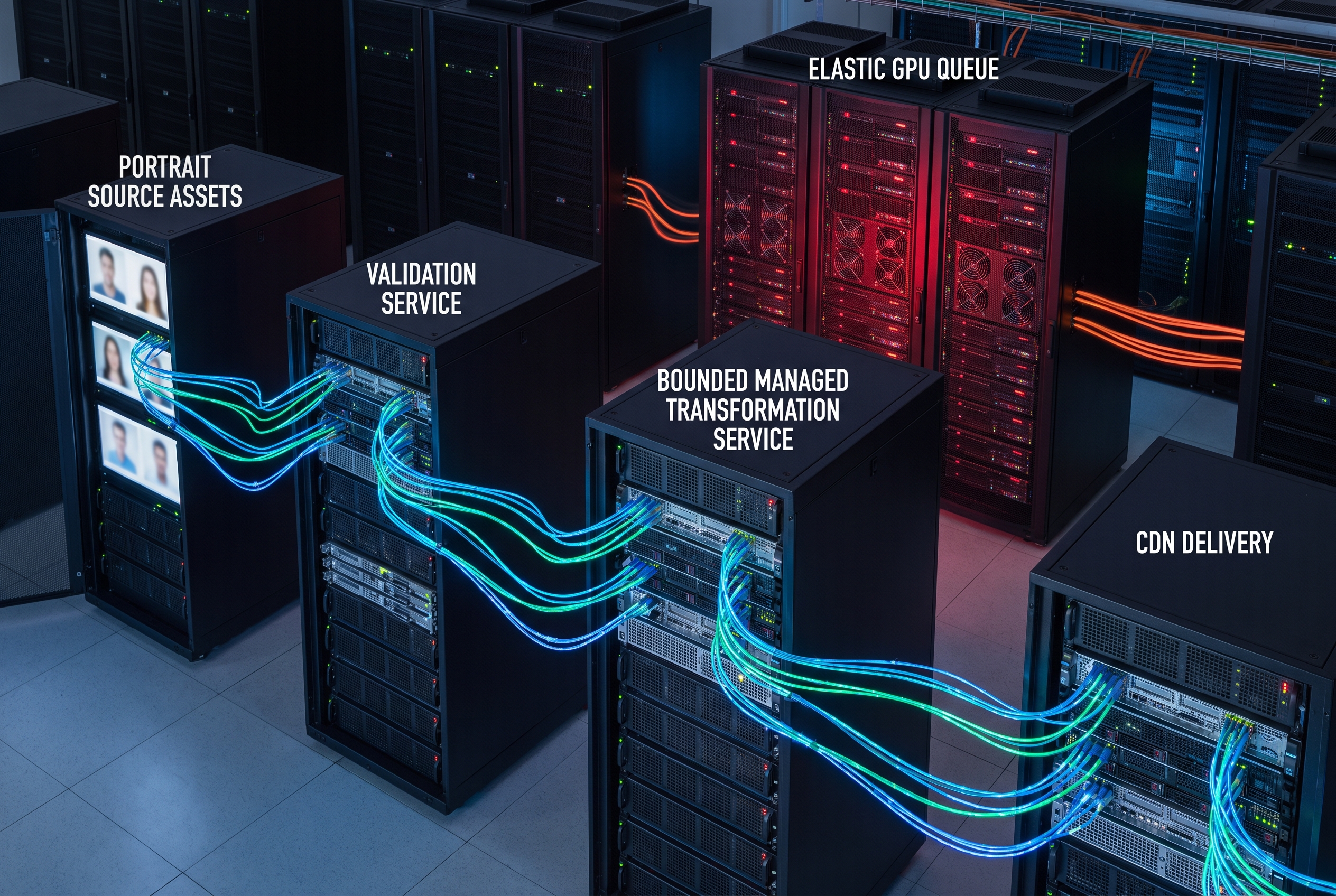
Use idempotency at the edge. Mobile clients retry after weak-network failures, and a duplicate request should attach to the original job rather than create two clips. Hash normalized inputs plus effect version and output profile when deduplication is acceptable. Keep a shorter cache lifetime for privacy-sensitive assets. The right retention period depends on the product, but it must be intentional.
Version the effect contract too. A visual change can alter framing, clip duration, codec settings, and output size. Include an effect version in the job record and avoid silently changing an in-flight request. This makes incident response practical: teams can isolate whether a failure belongs to input validation, a particular workflow version, encoding, or CDN delivery.
Numbers that decide whether to remove the visible GPU queue
Measure p50, p95, and p99 end-to-end latency, not just model runtime. Break the result into upload, queue wait, preparation, transformation, post-processing, and first-byte delivery. A low transform time can hide a slow object-store copy. A healthy accelerator metric can hide CPU saturation during image decode or video encode.
Track success rate by input class, retry rate, duplicate suppression rate, bytes processed per completed job, and queue age. For a consumer effect, a sensible service-level objective might be expressed as a percentile completion target and an error budget, rather than a promise that every request starts instantly. Pick targets from observed product behavior, not from a GPU dashboard.
Capacity planning should use concurrency and tail duration. If a bounded transformation has a 12-second p95 service time and needs 20 completed jobs per second at peak, the system needs roughly 240 concurrent jobs before allowing for retries and headroom. That is a planning estimate, not a benchmark. Recalculate it with measured service time, and separate CPU, memory, storage IOPS, network egress, and model-service limits. The slowest shared dependency sets the customer experience.
Cost attribution needs the same discipline. Tag jobs by effect version and tenant. Charge internal cost centers for ingest, transformation, storage, and egress separately. Otherwise a product team may celebrate lower accelerator usage while a transcode fleet or outbound delivery bill grows unseen. Kubernetes Jobs can fit finite, retryable worker stages; the Kubernetes Job documentation explains the completion-based execution model and its retry controls.
How infrastructure teams can roll this out
First, classify requests by variability. Put fixed effects, standardized exports, thumbnail generation, and deterministic packaging in the bounded lane. Keep prompt-driven creation, long renders, and high-resolution variants in the GPU queue. Reject ambiguous request types until the product contract is clear.
Second, run a shadow measurement period. Mirror job metadata rather than customer media where privacy rules require it. Compare queue wait, completion latency, retry behavior, and support tickets for each class. A split is working when the predictable lane has a stable tail and the exploratory lane retains enough guardrails for scarce capacity.
Third, make degradation explicit. If the managed transformation is constrained, return a retry-after value, offer an accepted output profile, or postpone nonessential thumbnail variants. Do not silently fall back to a slower open-ended render. That hides the real failure mode and turns a capacity incident into a product mystery.
Managed workflows marked as NoGPU in the Wiro model catalog show why a fixed input contract can be useful in product delivery. The right deployment is not anti-GPU. It reserves GPU queues for work that earns their variability, while bounded media operations get their own measurable path.
Run and scale models on Wiro when a product needs both exploratory generation and predictable media transformation without forcing them through one queue.