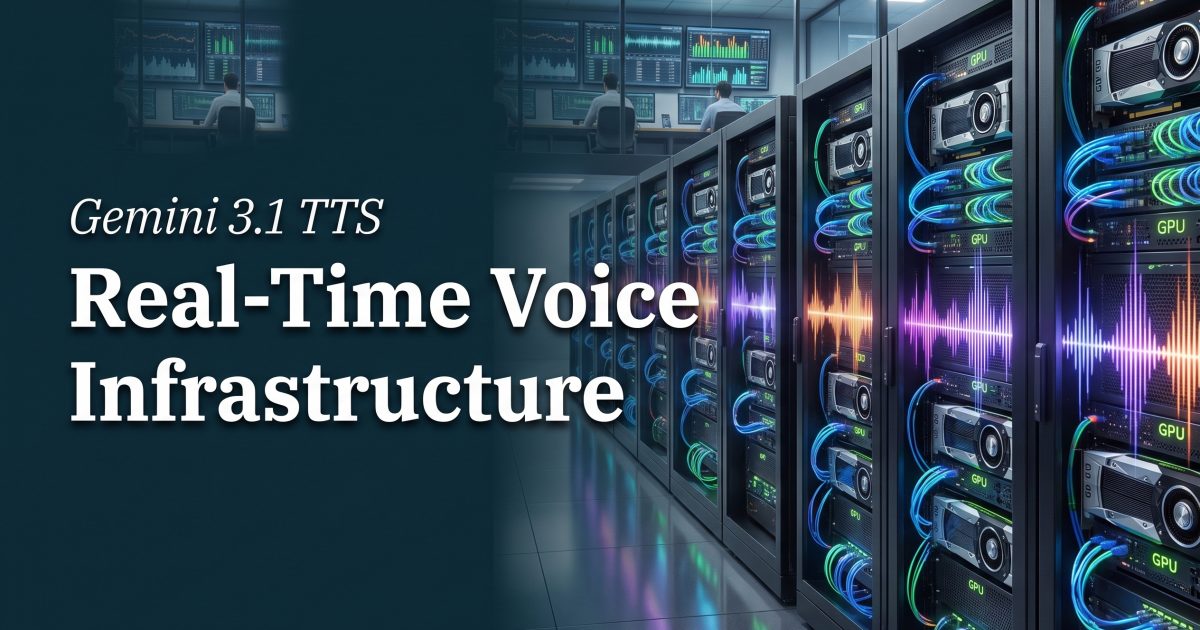
real-time voice infrastructure is becoming a first-class AI systems problem. Gemini 3.1 TTS turns text into natural speech with selectable voices and expressive controls for tone and pacing. That looks simple from an interface. In production, it makes latency, audio delivery, caching, capacity planning, and quality assurance part of the model-serving stack. Google describes Gemini 3.1 Flash TTS as supporting more than 200 audio tags, which means speech can be prompted for delivery as well as generated for content. That flexibility is useful, but it also expands the test surface for every voice application.
Real-time voice infrastructure starts with the response budget
A voice agent is judged by the gap between a caller finishing a sentence and the reply beginning. That gap is not one model metric. It is the sum of speech recognition or turn detection, retrieval, reasoning, text generation, text-to-speech synthesis, transport, decoding, buffering, and playback. A fast TTS model cannot rescue a workflow where an API call or a cold connection consumes the response budget.
For developers, separate the experience into measurable stages. Track end-of-turn to request dispatch, time to first audio byte, time to first playable audio, and completion time. The first playable audio metric is often the one users perceive. It captures both synthesis and delivery, and it exposes cases where an output exists but the client has not yet started playback.

Gemini 3.1 TTS adds control but demands evaluation
Google Cloud says Gemini 3.1 Flash TTS supports 200-plus audio tags for expressive prompting. That gives product teams a more direct way to specify delivery: pace, emotional tone, emphasis, pauses, or conversational style. It can make a support flow less robotic, a narrated report easier to follow, or an accessibility feature more comfortable to use.
It also creates a governance problem. A production voice should not vary unexpectedly because a prompt was loosely written. Define a small set of approved delivery templates and test them with the language, names, numbers, abbreviations, and punctuation patterns the application actually uses. Keep the text request separate from the style policy so that a content change does not silently alter the intended voice.
Google Cloud guidance for Gemini 3.1 Flash TTS is a useful primary reference for the expressive-tag capability. The Gemini speech-generation documentation describes single-speaker and multi-speaker generation patterns. Use those capabilities deliberately rather than treating every response as an open-ended acting prompt.
Streaming changes the architecture
For interactive voice, waiting for a complete audio file before delivery wastes time. Where the serving path supports it, stream audio in chunks and begin playback as soon as the client has enough buffered data. This introduces new operational details: codec selection, chunk duration, jitter tolerance, reconnect behavior, and what happens if a client interrupts the model while it is still generating.
Interruption handling matters more than a perfect synthetic voice. When a caller starts speaking, stop or duck playback quickly, cancel unnecessary downstream work, and retain enough state to answer the new request without rebuilding the whole conversation. That is a coordination problem between the media client, application runtime, and model gateway.

Capacity planning for real-time voice infrastructure
Audio inference is usually lighter than long-form video generation, but its latency target is stricter. A batch job can wait; a voice turn cannot. Plan capacity around concurrent active sessions, peak turn rate, audio duration, and p95 time to first playable audio. Do not estimate the fleet from average text length alone. A surge of concurrent users, longer generated replies, or retries after a network event can create a different load profile.
Cache what is stable. Consent wording, standard disclosures, common navigation prompts, and repeated status messages do not need fresh model inference every time. Pre-generated audio for those fragments can reduce both cost and tail latency. Do not cache personalized output or sensitive content without a clear policy, retention limit, and access boundary.
Practical reliability checklist
- Measure time to first audio and time to first playable audio at p50 and p95.
- Test difficult inputs: names, addresses, numbers, mixed languages, acronyms, and interruptions.
- Set a maximum reply length for live voice turns and summarize before speaking long passages.
- Keep voice templates versioned, with a small approved set of expressive controls.
- Use retries carefully: a duplicate spoken response is often worse than a brief fallback.
- Log request stage timings without storing unnecessary call content.
Why this is an infrastructure story
The GPU is only one part of a voice experience. The system also needs a fast network path, a responsive client, robust session state, and observability that distinguishes model latency from transport latency. The right objective is not maximum synthesized minutes per GPU. It is reliable, intelligible speech delivered at the moment a user expects it.
Gemini 3.1 TTS on Wiro is a useful building block for controlled speech generation. Run and scale real-time voice infrastructure on Wiro when your application needs responsive, measurable, and governed audio output.