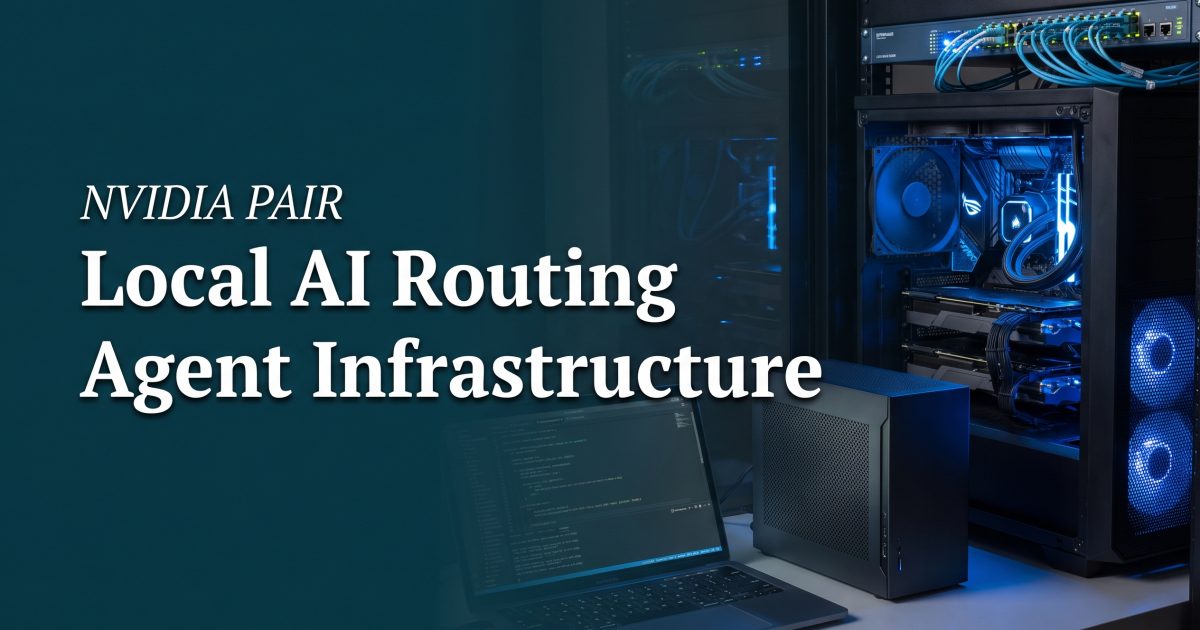
Local AI routing turns a shelf of separate machines into a usable pool for agent work. NVIDIA PAIR, now in beta, sits in front of compatible Ollama and LM Studio endpoints, discovers eligible devices on a local network, and places each independent inference request on one machine. That sounds modest. For a developer running several agents, it addresses a familiar failure mode: one GPU queue fills while nearby hardware sits idle.
What local AI routing does in PAIR
PAIR is a virtual inference router, not a distributed-model runtime. One request goes to one eligible node and stays there until completion. It does not split a single prompt across several GPUs or pool VRAM into one larger accelerator. That distinction matters when planning capacity. A 70B model that does not fit on any one node still does not fit because a router exists.
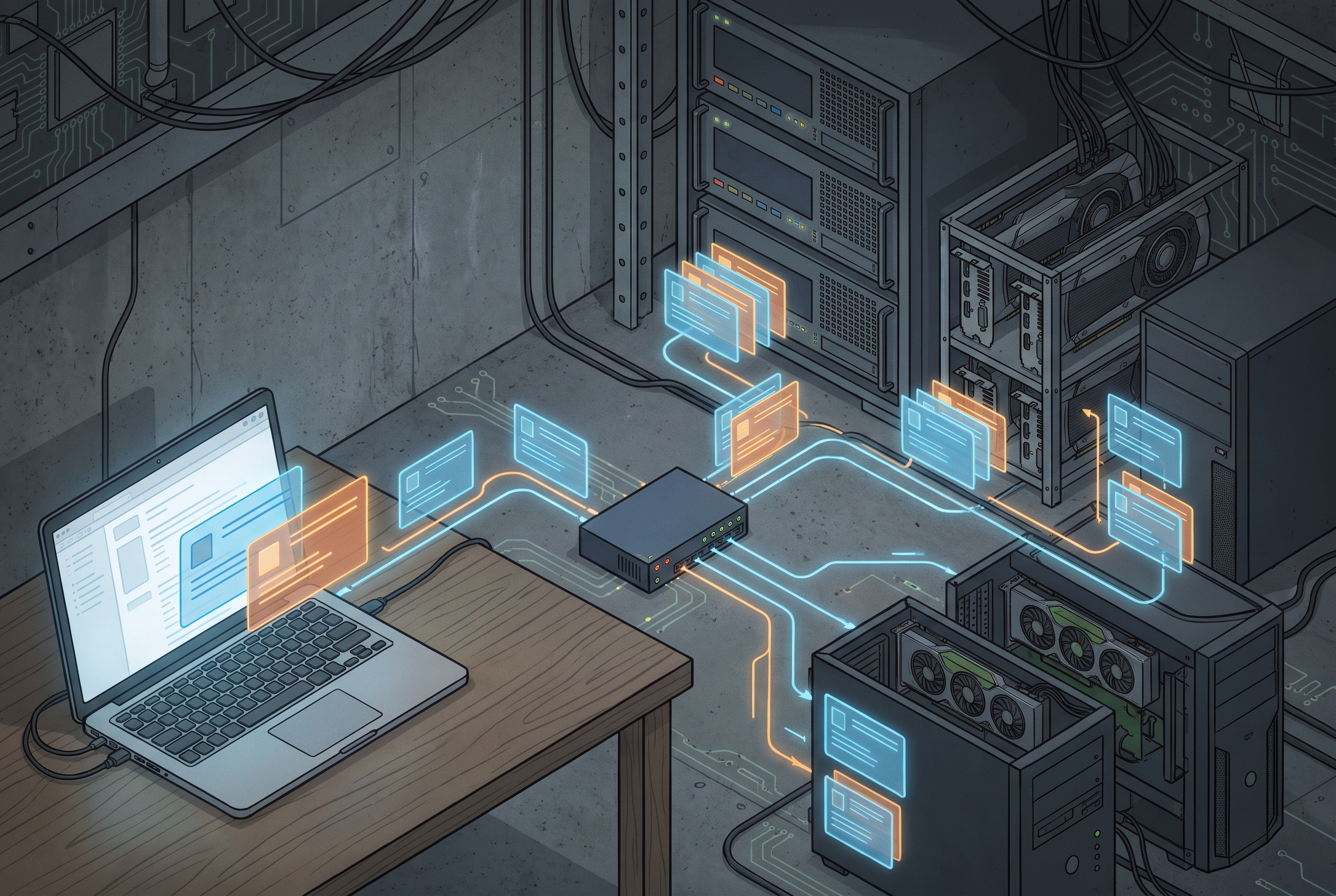
The routing layer keeps the client-facing interface familiar. NVIDIA says PAIR works with Ollama and LM Studio interfaces, so an agent harness can point at the router rather than learn a new cluster API. Behind that endpoint, PAIR tracks whether a node is online, whether a supported engine is ready, whether the requested model is installed, active jobs, and GPU utilization. The placement decision happens per request.
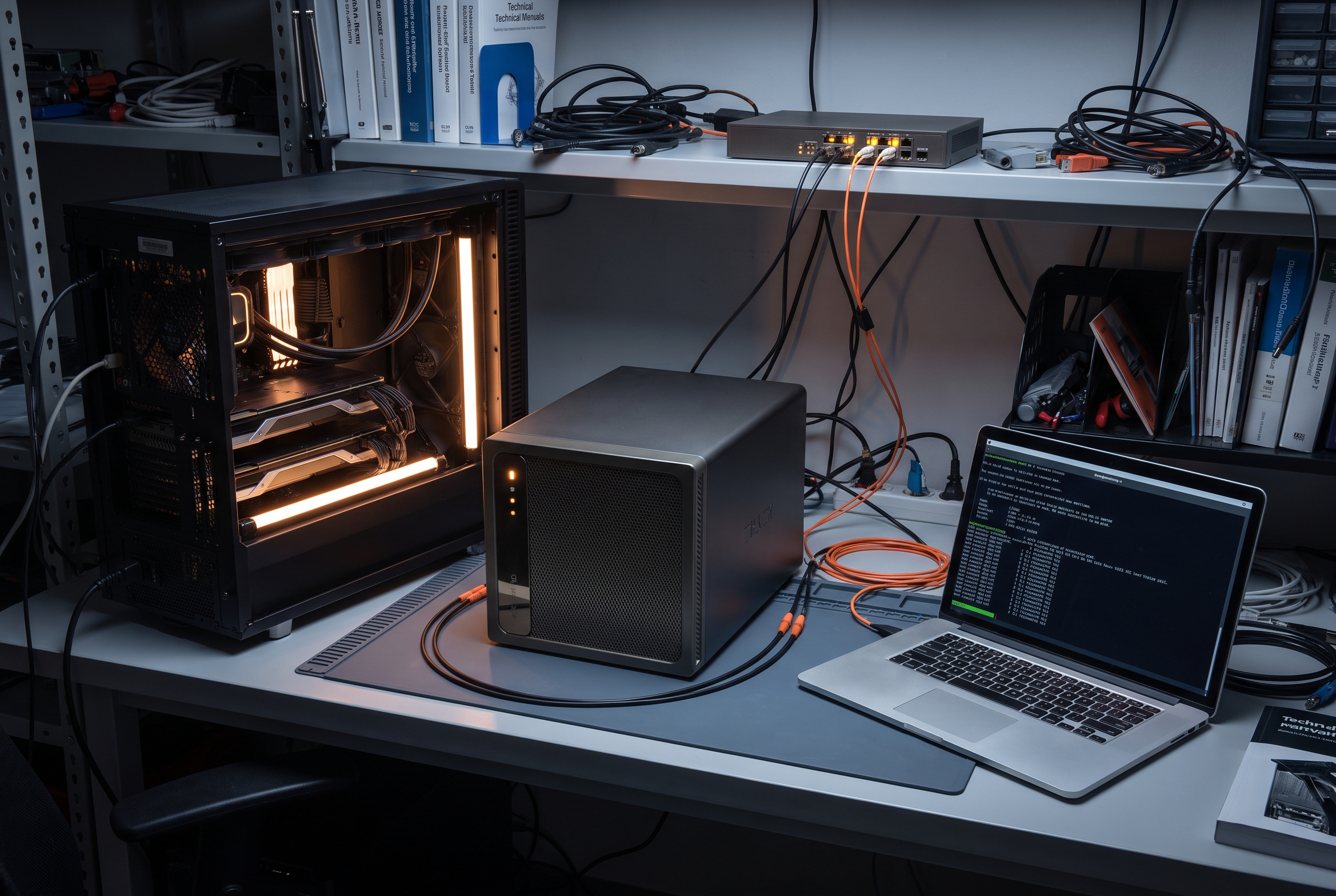
That makes PAIR useful for a heterogeneous lab. NVIDIA lists GeForce RTX 20 Series and newer GPUs, RTX PRO workstations from Turing onward, DGX Spark, and Apple M4 or newer silicon among supported systems. A Windows workstation, a small desktop system, and a Mac do not become identical machines, but they can become candidates when they host the required model and runtime.
Why agents create the local AI routing problem
A single chat session often creates a smooth stream of calls. Agent systems do the opposite. A planner can launch parallel research, code review, retrieval, tool-use, and synthesis tasks. Those requests may be short, but they land together. If every worker targets one local Ollama server, queueing becomes the bottleneck before raw token speed does.
PAIR targets request-level concurrency. A lead agent can keep one endpoint while independent workers fan out across ready nodes. This can protect the interactive machine, too. A workstation rendering video or running a game can advertise less available capacity, while an idle laptop or DGX Spark takes an agent request. The benefit is not magic acceleration. It is less waiting behind unrelated work.
Privacy is another reason to consider the pattern. Prompts, retrieved documents, and model responses remain on the existing local network rather than crossing a public inference endpoint. That does not remove security work. A local network still needs device controls, patching, and a clear policy for which connectors may send data elsewhere. It does give teams a tighter boundary for source code, customer records, and internal notes.
The 8 minute 48 second demo is a signal, not a capacity plan
NVIDIA published a five-subagent Hermes Desktop demonstration using Ollama and Qwen 3.6 35B A3B. On one RTX Spark laptop, the workload averaged 18 minutes. A three-device PAIR cluster made up of an RTX Spark laptop, DGX Spark, and RTX 5090 averaged 8 minutes 48 seconds. That is a reduction of 9 minutes 12 seconds, or roughly 51% versus the single-device run.
The company labels it an unofficial, configuration-specific demonstration. Treat it that way. The result depends on how much work can run independently, model residency on each node, prompt lengths, engine settings, network conditions, GPU contention, and node availability. A serial agent chain will not get the same gain. A workload with five ready tasks can; one with a single long generation cannot.
Still, the arithmetic is useful. The three-node result is not close to a 3x speedup, which is realistic. Scheduling overhead, uneven task lengths, model warm-up, and the final synthesis step all leave parallel capacity unused. Infrastructure teams should expect a curve that flattens as the serial portion of a workflow grows. Measure end-to-end task completion, not only tokens per second on one node.
A practical deployment design for developers
Start with a narrow pilot. Put two or three machines on the same trusted LAN. Install the same model version where it is needed, expose only the required local inference service, and route one reproducible agent workload through PAIR. NVIDIA describes mDNS discovery and mutual TLS pairing in the project, which is a better starting point than manually trusting any host that answers on a port.
Use eligibility rules before load balancing
Build a small routing matrix. For example, keep a code-assistant model on the workstation that holds the repository cache; allow document summarization on any node with the correct weights; keep vision jobs on the GPU with enough memory; and reserve the primary desktop for interactive work. Model presence matters as much as utilization. Sending a request to an empty node just shifts the delay into a download or cold start.
Instrument the workflow, not just the router
Log request arrival, selected node, queue time, time to first token, completion time, retries, model version, and failure reason. Separate router queue time from engine queue time. Pair those metrics with GPU utilization and network latency. The PAIR Jobs view can show where inference ran, but agent count and router job count are different: one agent can produce several model calls.
Plan fallbacks explicitly
Nodes will sleep, lose Wi-Fi, run out of memory, or become busy. Decide whether a failed local request retries on another eligible machine, waits, or moves to a remote provider. Put a deadline on each class of work. A background document classification task may wait five minutes. An interactive coding request may need a 20-second ceiling and a clear fallback. Keep idempotency keys around tool calls so a retry cannot submit the same external action twice.
Limits and operating rules
PAIR does not replace centralized GPU fleets. It cannot give one request the aggregate VRAM of three machines, and it cannot make a weak local network disappear. It is best suited to independent calls, stable local model inventories, and users who already have capable devices. Teams with bursty, shared production traffic may still need a centralized scheduler and remote capacity for predictable service levels.
There is also a model-operations cost. Pin runtime and model versions, document the quantization used on each node, and test output consistency before mixing devices in a workflow. A tool-calling agent may behave differently if one node runs a different template or a stale model build. Keep a small approved catalog rather than routing against whatever happens to be installed.
For developers, the practical takeaway is simple: use local AI routing to widen concurrency, not to promise linear GPU scaling. First identify independent requests. Then make model availability, security boundaries, fallbacks, and measurement visible. NVIDIA’s technical PAIR walkthrough documents the supported interfaces, hardware, scheduling signals, and the five-agent demonstration. The open-source PAIR repository is the right place to inspect deployment details before adopting it.
Local clusters and remote capacity solve different parts of the same problem. Run and scale the models that fit each path with Wiro.