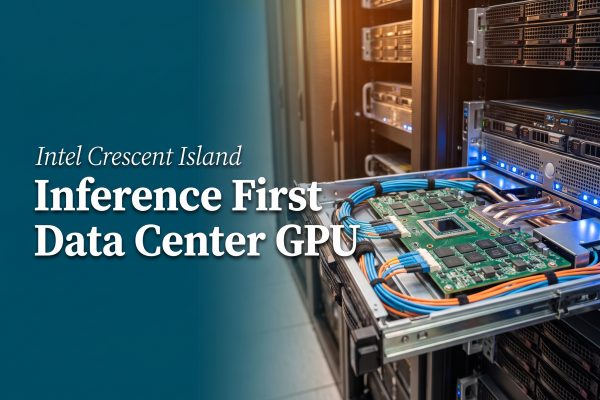
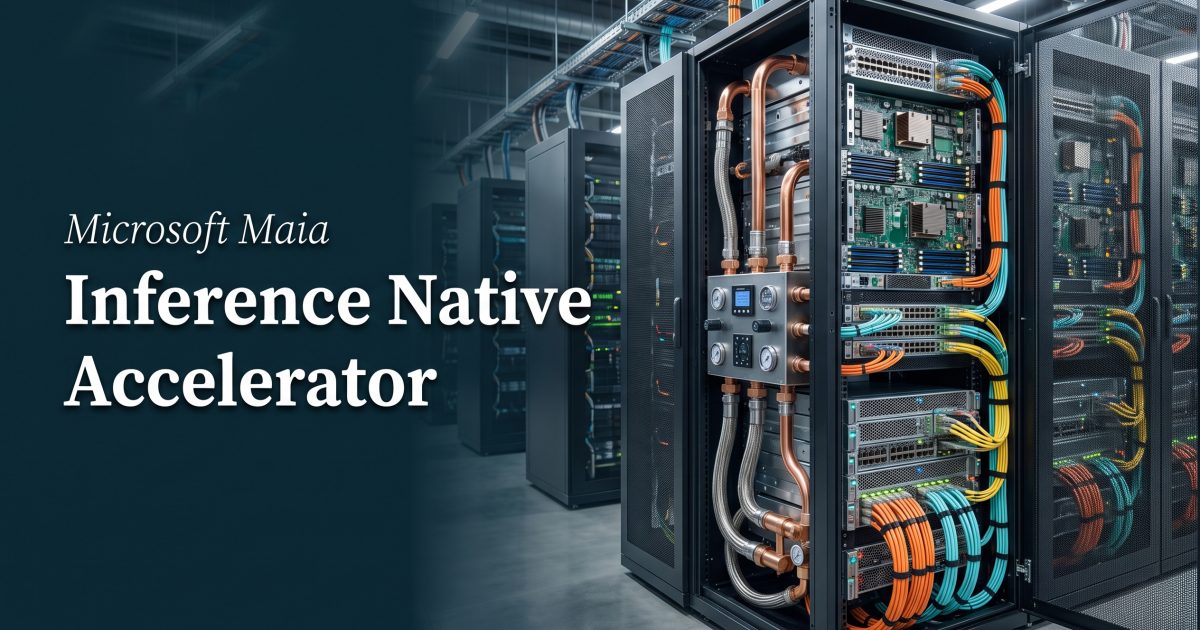
Inference-native accelerator design changes the question infrastructure teams ask about AI serving. Microsoft Maia 200 is not positioned as a general replacement for every GPU workload. It targets the expensive path after a model is trained: producing tokens under real traffic, with latency, memory pressure, power, and utilization all in play. Microsoft says the chip delivers 30% better performance per dollar than the latest generation hardware in its fleet. That claim needs workload-level validation, but the architecture explains why the target has shifted.
What an inference-native accelerator changes
Microsoft built Maia 200 on TSMC 3 nm technology. The accelerator has more than 140 billion transistors, native FP4 and FP8 tensor cores, 216 GB of HBM3e, 272 MB of on-chip SRAM, and 7 TB/s of memory bandwidth. Its stated envelope is 750 W TDP, with more than 10 petaFLOPS at FP4 and more than 5 petaFLOPS at FP8. Those figures come from Microsoft’s Maia 200 announcement.
The detail that matters most is not the peak number. Token generation repeatedly reads model weights and the key-value cache. That makes memory capacity, bandwidth, data movement, and scheduling decisive. A chip with abundant compute can still sit idle when memory or communication falls behind. Maia 200’s narrow-precision focus, specialized DMA engines, on-die SRAM, and network-on-chip are aimed at keeping those paths busy.
FP4 and FP8 also signal the deployment profile. Many inference stacks now quantize weights and activations when quality permits. Lower precision reduces the bytes moved per operation and can raise throughput, but it does not remove the need for model-specific accuracy checks. A team serving code generation, financial extraction, or multilingual support should compare task quality before treating a lower-bit configuration as a cost win.
The system is the product
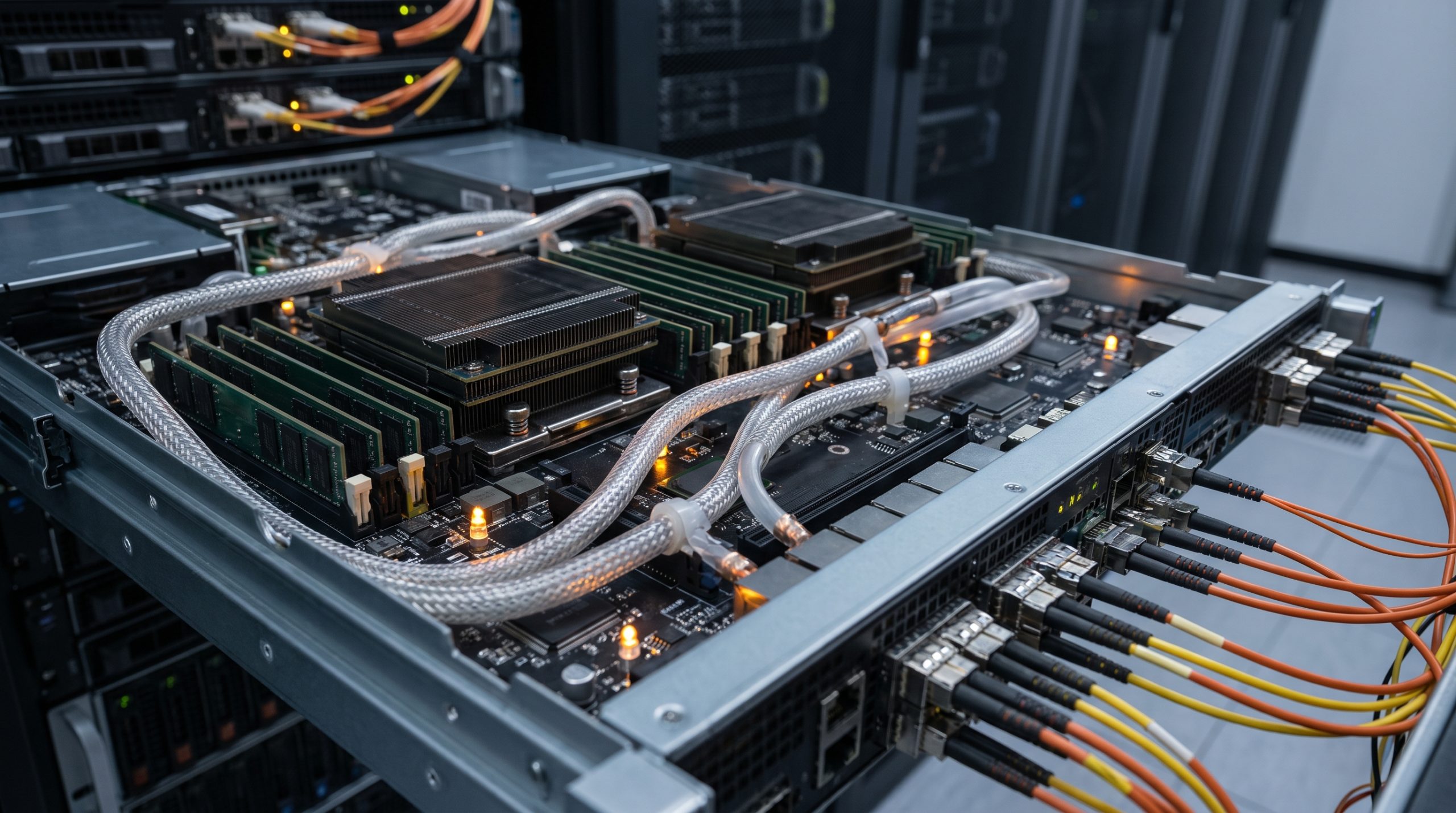
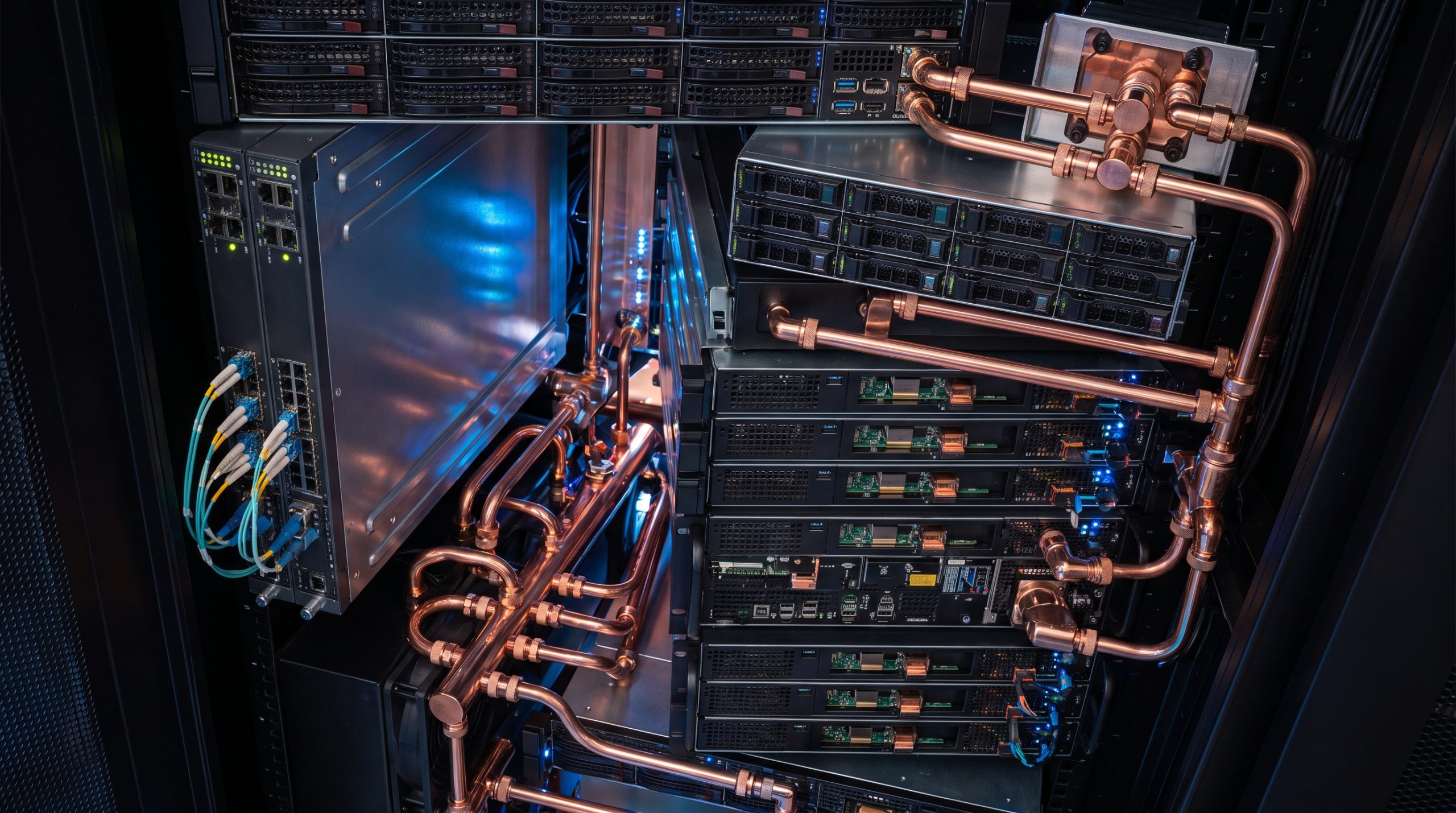
Maia 200 shows why inference hardware cannot be evaluated as a PCIe card alone. Microsoft describes a two-tier scale-up network built on standard Ethernet, with a custom transport layer and integrated NIC. The company also uses closed-loop liquid cooling and Azure control-plane integration for telemetry, diagnostics, security, and rack management. The public rollout began in Azure US Central near Des Moines, with US West 3 near Phoenix named as the next region.
That integration has a practical consequence. A provider can align compilers, kernels, network transport, cluster scheduling, and failure handling around a smaller set of target workloads. Microsoft says Maia SDK preview tooling includes PyTorch integration, a Triton compiler, optimized kernels, a low-level language called NPL, a simulator, and a cost calculator. That is the real developer story: a new accelerator only changes production economics if the software path makes it usable.
Microsoft also says Maia 200 will serve multiple models, including GPT-5.2 models in Microsoft Foundry and Microsoft 365 Copilot. It plans to use the hardware for synthetic-data generation and reinforcement-learning workloads. This is a heterogeneous fleet strategy, not a single-chip bet. General GPUs can remain the flexible route for new models, unusual operators, training, and fast-moving research. A specialized path earns its place when traffic is stable enough to justify the optimization work.
What developers should measure on an inference-native accelerator
Do not benchmark a serving platform with one clean prompt and one concurrent request. Capture production-shaped traces. Split prompts by input length, output length, model, tool use, cache hit rate, and priority. Measure time to first token, inter-token latency, p50 and p95 end-to-end latency, accepted requests per second, error rate, and tokens per joule. Add cost per completed task, not just cost per million tokens.
Context length deserves its own test. A 216 GB HBM pool can improve the placement options for large weights and active KV cache, yet the useful result depends on batch size, parallelism, quantization, and cache policy. Prefix caching can turn repeated system prompts or document headers into a major saving. It can also create uneven memory pressure when traffic mixes short chat turns with long retrieval contexts. The vLLM KV-cache design documentation is a useful reference for understanding why cache layout and block sizing affect serving behavior.
Kernel coverage is another gate. The same model may perform differently across attention variants, mixture-of-experts routing, rotary embeddings, and quantization formats. Start with supported reference models and known-good precisions. Then validate custom layers, adapters, and decoding settings against a baseline. A fast unsupported path is not an option in a production incident.
Four practical takeaways for infrastructure teams
- Separate prefill from decode in the metrics. Long prompts stress memory and bandwidth differently from steady token decode. One blended throughput number hides both behaviors.
- Keep a portable baseline. Maintain a GPU deployment and a common request trace. It provides a fallback and prevents a compiler-specific optimization from becoming an unmeasured dependency.
- Plan capacity around tail latency. Mean throughput does not protect an interactive product. Leave room for cache misses, failovers, hot models, and uneven tenant demand.
- Treat power and cooling as capacity inputs. At a 750 W chip envelope, rack density, coolant distribution, and maintenance windows shape usable capacity. The facility plan belongs in the inference review.
Where Maia 200 fits
Maia 200 matters because it pushes accelerator design toward the economics of the next token. The comparison is not custom silicon versus GPUs in the abstract. It is whether a full stack can serve a known workload with better quality-adjusted latency and lower total cost. Microsoft’s reported 30% performance-per-dollar improvement is a provider claim, not a universal benchmark. Teams should wait for workload-specific measurements, then compare against their own traffic.
For developers, the near-term value is access to more deployment choices and tools that expose the tradeoffs. For platform teams, the lesson is sharper: inference performance is a memory, network, software, cooling, and operations problem. The chip starts the conversation. It does not finish it.
Run and scale AI models with Wiro.