
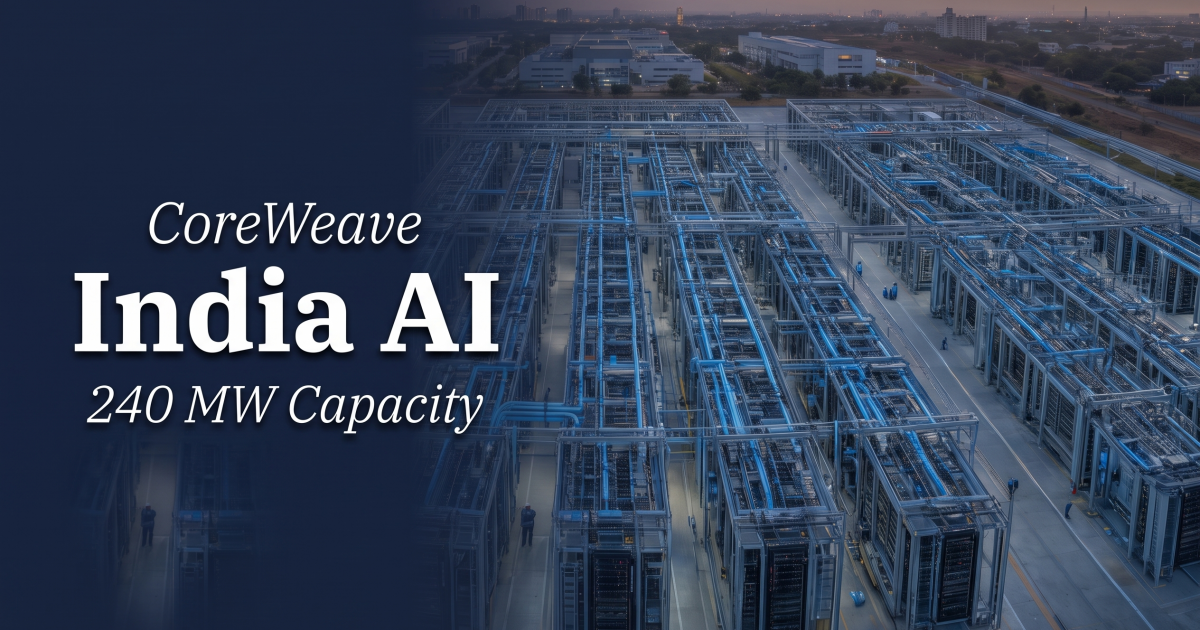
CoreWeave India AI capacity is moving from a cloud strategy slide to a 240 MW build plan in Navi Mumbai. The announcement matters because it ties power, cooling, accelerator choice, and local tenancy into one deployment. It is a useful reminder that AI cloud expansion now starts with the site design, not a GPU shopping list.
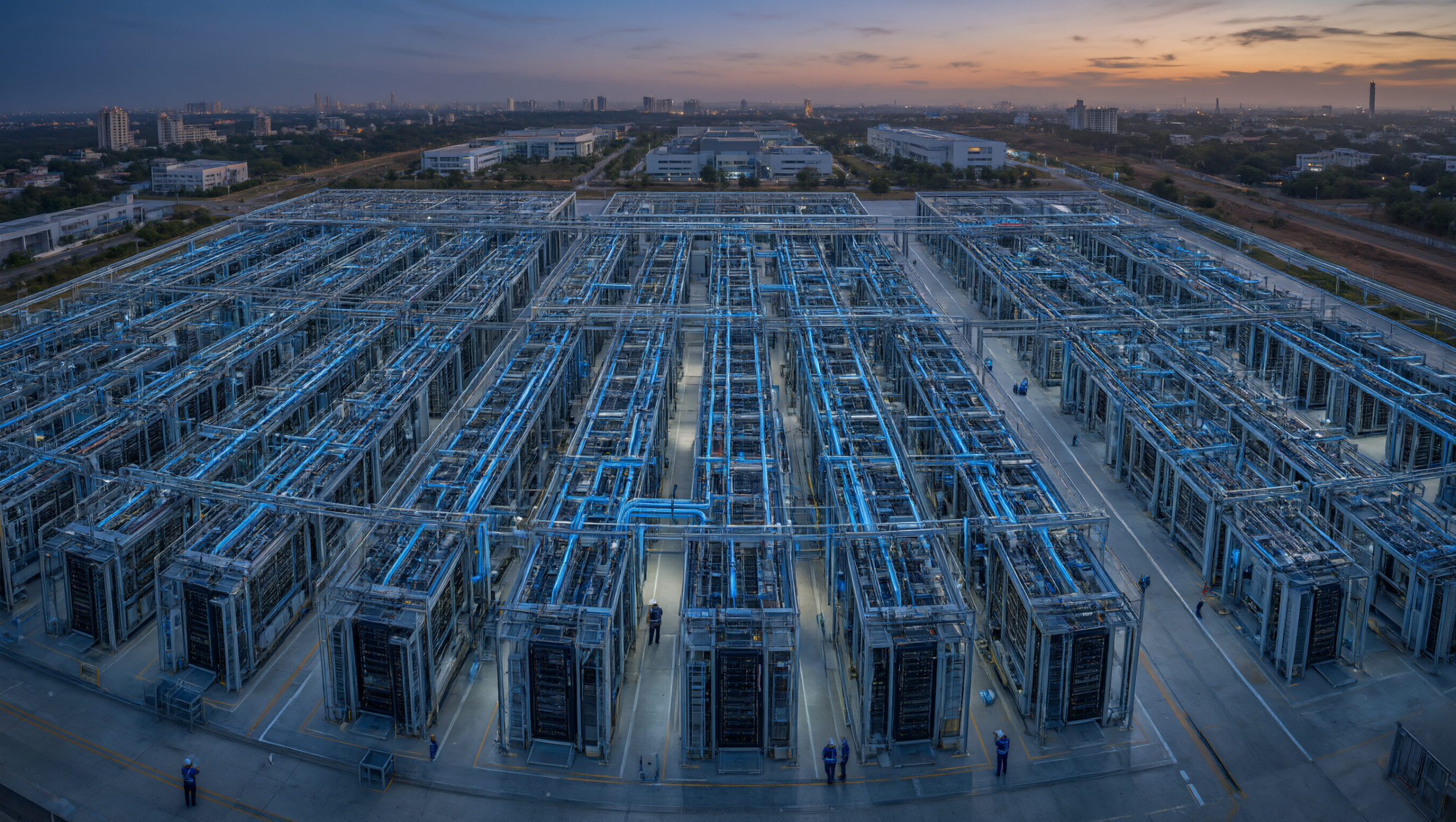
CoreWeave plans three 80 MW buildings at AdaniConneX’s Taloja campus. The first phase is expected in mid-2028, with later phases following. CoreWeave will be the sole tenant, and the campus could add another 240 MW. That makes the first 240 MW a capacity foothold rather than a fixed endpoint.
What 240 MW means for AI capacity
Megawatts are not a GPU count. They are the boundary that every GPU count must fit inside. The three-building plan gives CoreWeave room to stage electrical gear, chilled-water systems, network fabric, storage, and GPU halls as separate capacity decisions. That matters more than a single large hall when hardware generations and rack power keep changing.
At this scale, utilization becomes an infrastructure problem. A cloud provider cannot simply fill racks and call the project complete. It needs customer demand that arrives close to the time each phase goes live, enough power delivery to keep accelerator clusters busy, and network capacity that does not turn multi-node work into an expensive waiting room.
The India build also shifts the discussion away from generic regional availability. A dedicated tenant can tune hardware, queue policy, storage, and support around a narrower operating model. That does not guarantee low latency or low cost. It does make it easier to control the failure modes that show up when large training, inference, reasoning, and agent workloads share a general-purpose cloud.
CoreWeave India AI design choices are the real story
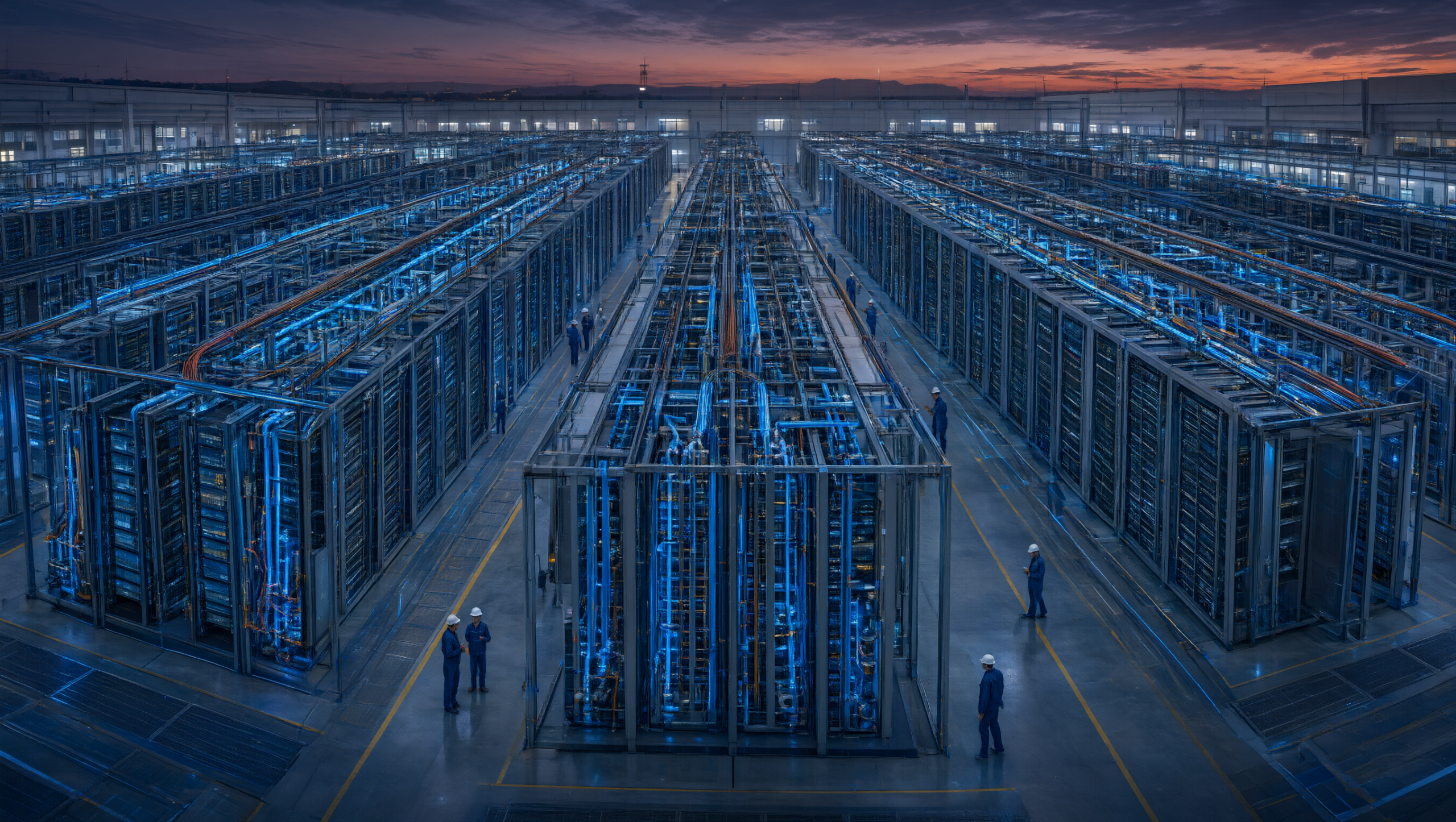
CoreWeave’s announcement says the campus is designed for high-density AI infrastructure, with direct liquid cooling in GPU data halls and a non-evaporative chilled-water system. Those details deserve more attention than the headline number. Cooling architecture determines which rack densities are practical and how much operational flexibility remains when ambient conditions change.
Direct liquid cooling is becoming a planning tool, not a premium feature. It moves more heat than air at the point where dense accelerator racks generate it. The trade-off is a more demanding facility design: loops, manifolds, service procedures, leak detection, and spare parts become part of the platform. For CoreWeave India AI capacity, that work is baked into the campus rather than added after the racks arrive.
The announced plan also calls for NVIDIA’s Vera Rubin platform. That is a forward-looking hardware choice, so the useful question is not whether the first rack uses every promised feature. It is whether the building can accept the power and cooling profile of later systems without a redesign. Sites that can absorb a new generation without rewriting the mechanical plan hold a major advantage.
The 2028 timing problem
A mid-2028 first phase is both the strength and the risk of the project. It gives the operator time to align a large campus with future hardware, but it leaves room for demand, accelerator supply, power delivery, and customer economics to move. Capacity announced today is not capacity an application team can reserve tomorrow.
That delay puts a premium on phased commissioning. Each 80 MW building can become an operational checkpoint: validate cooling behavior, prove network design under load, measure queue performance, then carry those lessons into the next phase. The alternative is a single large launch where every subsystem reaches production pressure at once.
CoreWeave said it had about 4.2 GW of contracted power in August. Against that figure, 240 MW is meaningful but not dominant. Its value lies in geography and design. A purpose-built campus near customers can make regional capacity more predictable for workloads that cannot tolerate long queues, data movement surprises, or broad swings in availability.
What builders should watch next
Three markers will show whether the project changes the regional market. First, watch for confirmed power delivery milestones, not just construction updates. Second, watch how the Vera Rubin deployment is defined: rack density, networking, and service model will reveal more than a platform name. Third, look for the first workload mix. Training, batch inference, real-time inference, and agent runs stress the same campus in different ways.
The most useful customer question is simple: what gets reserved? A capacity reservation should specify more than accelerator class. It should describe networking, storage path, queue policy, maintenance windows, and the response when a whole rack or fabric segment fails. That is where an AI cloud turns physical capacity into a usable service.
CoreWeave India AI is therefore a capacity story with a systems angle. The 240 MW figure sets the ceiling for the first stage. Cooling, electrical design, networking, and phased operations decide how much of that ceiling becomes dependable compute. Teams planning regional model serving should track those details before treating the announcement as available capacity.
For production teams that need to test, route, and scale model workloads, run and scale models on Wiro while capacity plans turn into operating infrastructure.