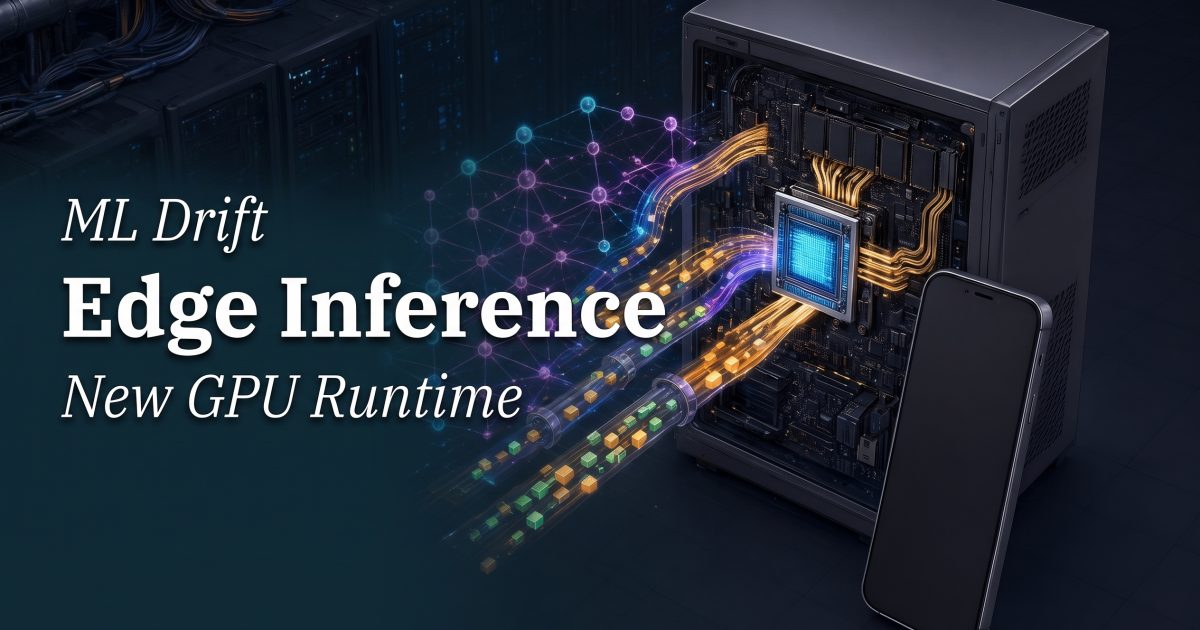
ML Drift edge inference is Google AI Edge’s new open-source GPU compute engine for running machine learning workloads across varied device hardware. Its value is not a headline benchmark. It is a runtime-layer change that moves GPU differences, tensor layouts, and kernel choices below an application stack that has become hard to maintain.
Google released ML Drift on October 8 as the GPU engine behind the LiteRT ML Drift accelerator and as a standalone C++ library. The project targets OpenGL ES, OpenCL, Metal, and WebGPU. That range matters because local inference rarely runs on a tidy fleet of identical accelerators. It runs across phones, laptops, browsers, embedded systems, and workstations with different drivers and memory behavior.
ML Drift edge inference changes the runtime boundary
The old pattern was familiar: ship a model, select a platform delegate, then spend weeks investigating device-specific regressions. A model that looks fine on one mobile GPU can fail a latency target on another because shader compilation, buffer placement, synchronization, or driver behavior changed underneath it. That work becomes more expensive as applications mix vision, audio, diffusion, and small language models.
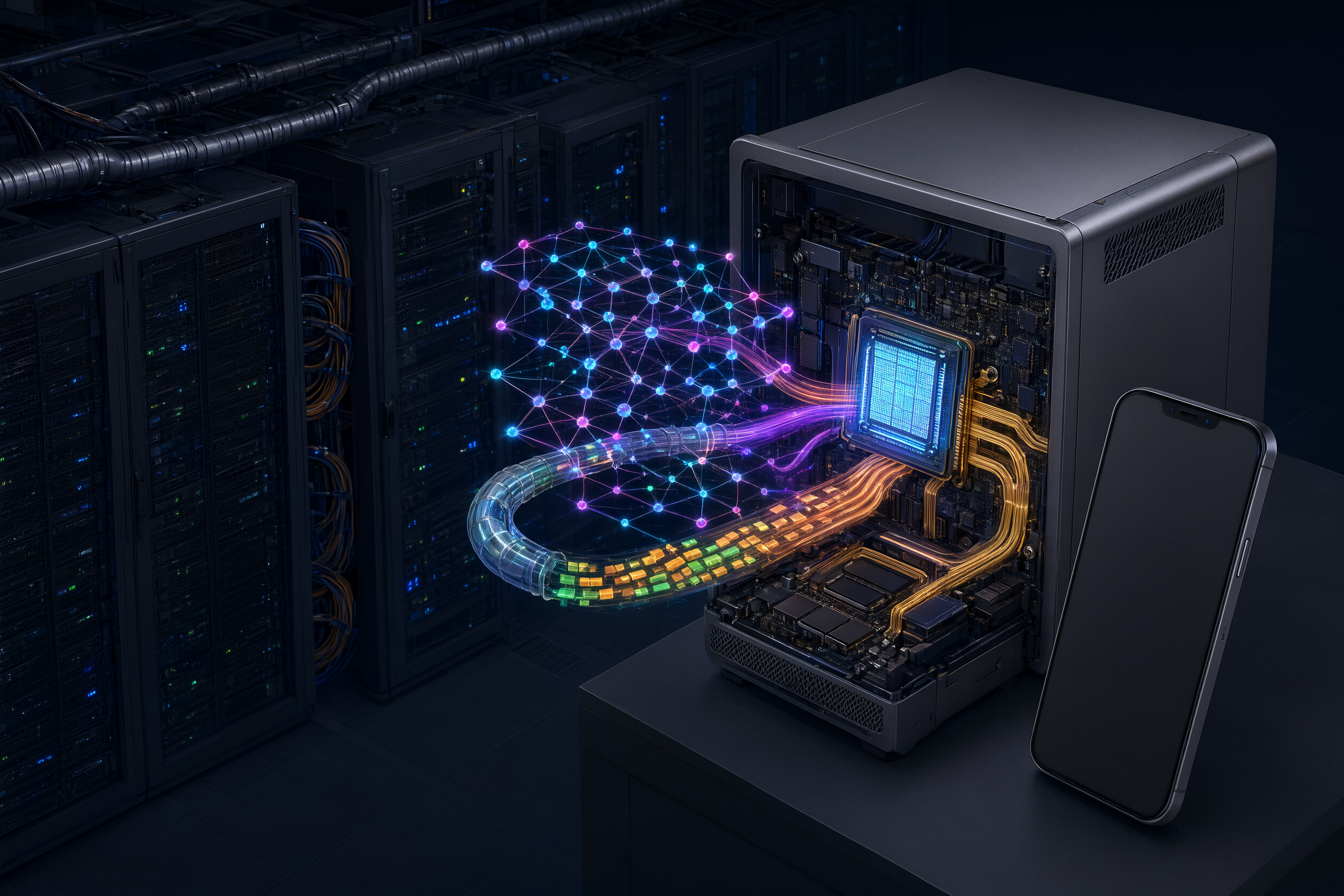
ML Drift tries to remove part of that burden. Google describes tensor virtualization as the central architectural change. Instead of maintaining separate shader paths that bind logical tensors directly to physical textures and buffers for every backend, the runtime resolves those mappings during initialization. The goal is one shader model with less backend-specific code while preserving portable execution.
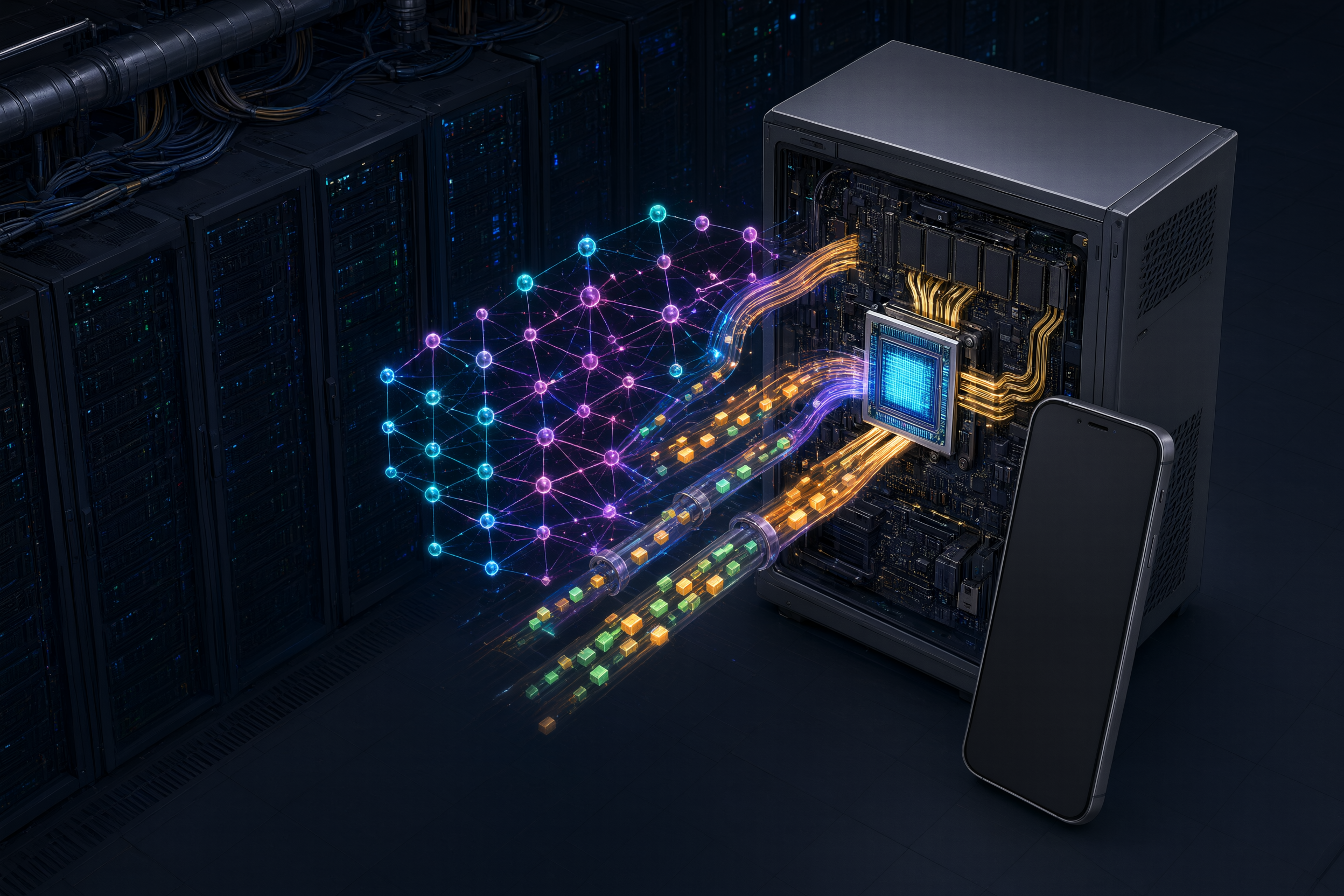
That is a meaningful infrastructure change even when an application does not change its model. The runtime becomes the place to absorb variation. A team can focus on model packaging, input ownership, batching rules, and fallbacks rather than treating each GPU API as a separate product.
Memory movement is the real edge bottleneck
Edge inference is not just a smaller version of data center inference. Mobile and client devices have tighter thermal limits, shared memory, irregular GPU capabilities, and more contention from the rest of the app. A fast kernel can still lose if the pipeline copies tensors between CPU and GPU memory or blocks while another stage waits for synchronization.
The LiteRT GPU acceleration documentation points to two practical controls: GPU-backed buffers and asynchronous execution. Zero-copy paths avoid needless round trips through CPU memory. Asynchronous scheduling lets CPU, GPU, and other accelerators keep moving instead of serializing a whole request behind one stage.
These details shape what users feel. A camera feature, local assistant, or live transcription pipeline is measured by end-to-end response time, not by the fastest isolated operator. The useful question is whether a frame or token reaches the next stage without waking the CPU, reallocating a buffer, or stalling on a fence.
Prefill and decode cannot share one optimization plan
Language models make the split especially clear. Prefill consumes a prompt and tends to reward compute throughput. Decode emits tokens one at a time and often hits memory bandwidth and cache management limits first. A runtime that uses one static layout for both phases leaves performance on the table.
Google says ML Drift changes kernels and layouts by stage. During decode, it uses a custom convolution-aligned KV cache layout and in-kernel activation quantization to reduce redundant memory movement. The announcement reports up to 12% lower memory overhead in its Gemma benchmarks. That is not a universal performance promise, but it highlights the right operational metric: memory headroom determines which local workloads can run together.
For developers, this means capacity planning should separate prompt-heavy jobs from steady generation. A local agent that ingests long documents has a different pressure profile from a short interactive assistant. The first may need prefill throughput. The second may need predictable decode latency, lower cache pressure, and a hard ceiling on concurrent sessions.
Portability now reaches more than phones
ML Drift starts from edge constraints, but its WebGPU path reaches Windows and Linux workstations through Dawn. That matters for teams that develop on laptops, validate in browsers, and deploy to mobile devices. A shared compute layer does not erase hardware differences, yet it can reduce the number of runtime architectures that need independent maintenance.
Google also added 5D tensor support to its LiteRT GPU accelerator. That removes a structural limit from older GPU delegate designs and gives spatiotemporal and volumetric workloads a more direct path. It is relevant for video understanding, multi-frame effects, and other pipelines that previously had to reshape data or route parts of execution elsewhere.
Arm’s technical overview of its ML Drift work adds more context. Its optimizations focus on Mali GPU kernels, texture cache locality, resource configuration, and device-aware workgroup selection. That is the unglamorous layer where cross-platform inference succeeds or fails. Hardware-aware work still exists. The difference is that more of it can live inside the runtime instead of every application.
A practical migration checklist
Do not start with a model benchmark. Start with the deployed pipeline. Measure end-to-end latency by device class, including input conversion, buffer copies, GPU dispatch, post-processing, and UI synchronization. Split the data into prefill and decode where language models are involved. Record memory high-water marks and thermal behavior, not just average speed.
- Keep a CPU or NPU fallback for unsupported operators and device-specific failures.
- Use GPU-backed input and output buffers where the application already owns GPU resources.
- Test cold start separately from steady-state execution because shader and model setup can dominate the first request.
- Set concurrency limits from memory headroom, not the best single-request result.
- Track p50 and p95 latency on representative devices, then inspect regressions by GPU family and driver version.
The release is most useful for teams that have reached the point where local inference has become a systems problem. For a one-off demo, a delegate switch may be enough. For an application shipping across Android, iOS, browsers, and desktop hardware, consolidating the runtime boundary can cut a growing maintenance cost.
ML Drift does not remove the need for profiling. It makes profiling more likely to reveal application choices instead of an endless collection of backend quirks. That is a better foundation for edge AI that needs to stay responsive as models and device hardware both change.
Run and scale production AI workloads on Wiro.