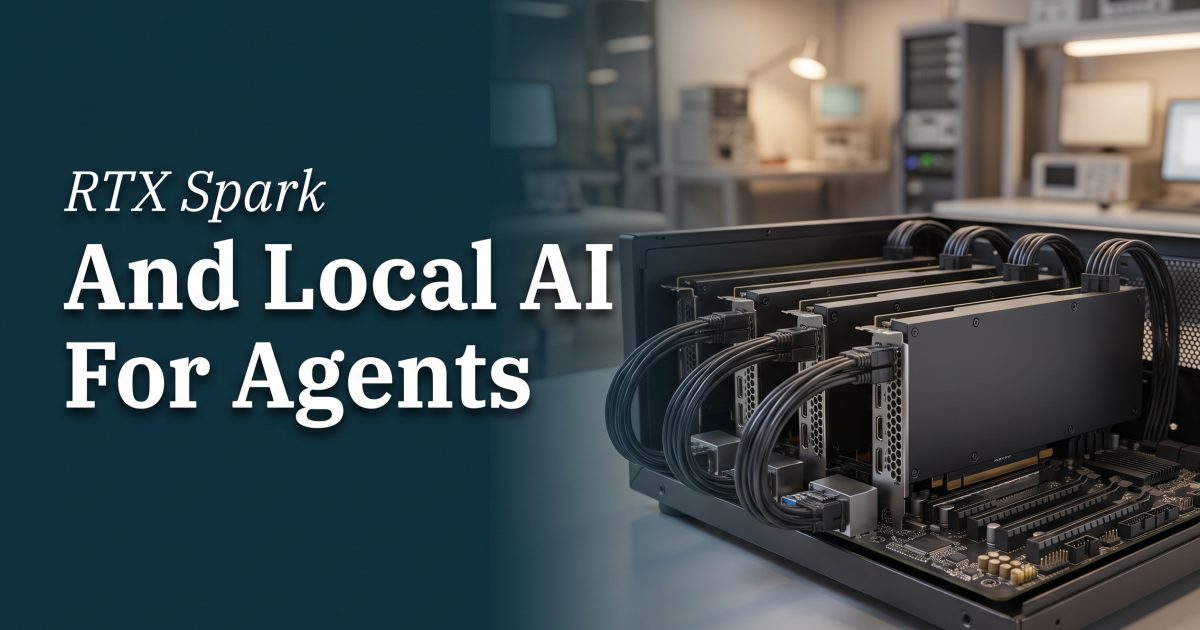
Local AI inference is moving from a side project to a deployment choice for agent systems. NVIDIA’s IFA 2026 announcements matter because they join three layers that have often been separate: local-capable models, faster runtimes, and routing across nearby machines. RTX Spark PCs are part of that shift, but the useful story is not a tiny server under a desk. It is a new topology for deciding where each agent step runs.
Local AI inference changes the agent topology
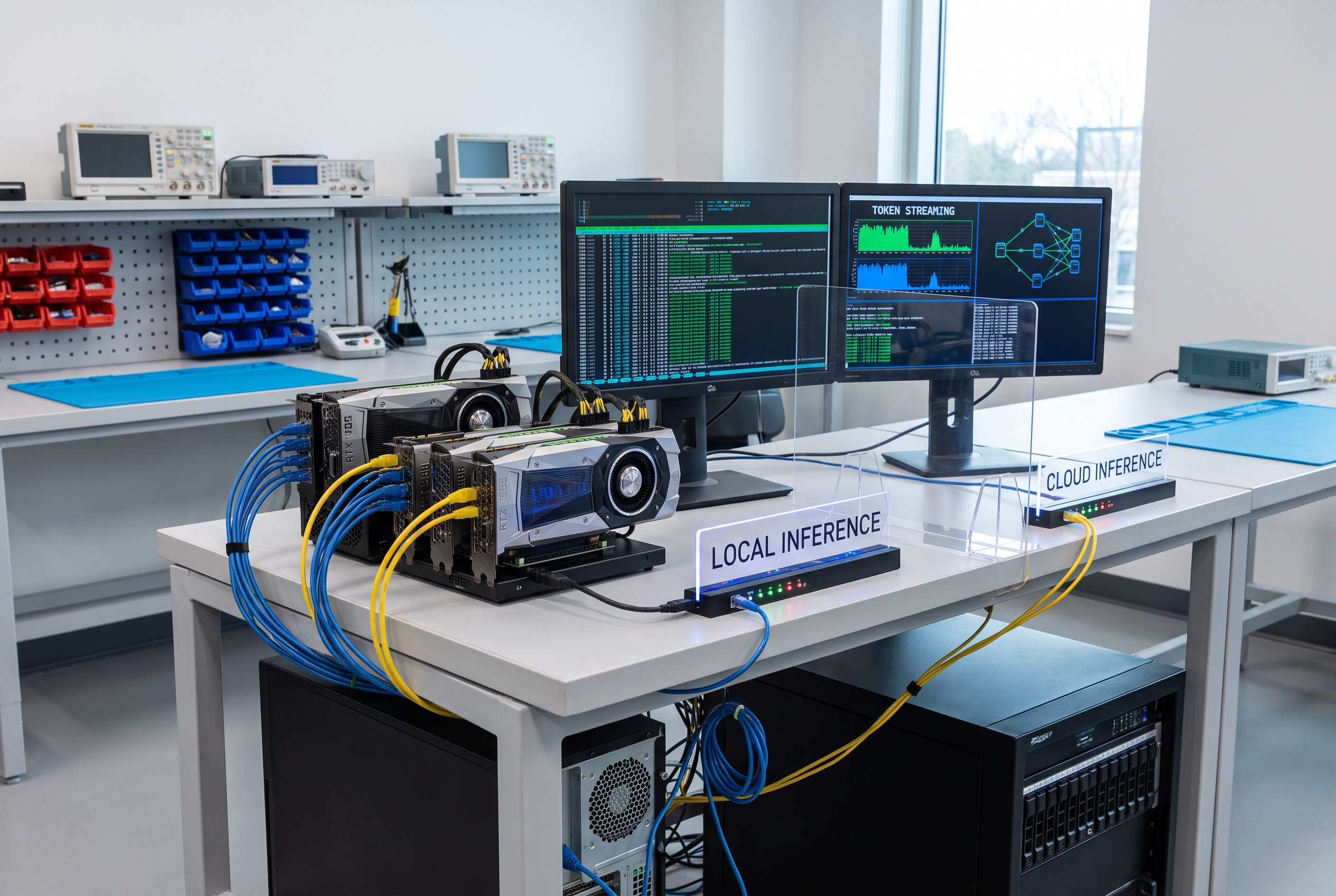
An agent does not produce one answer and stop. It reads files, retrieves context, calls tools, checks results, and often repeats the loop. A remote model can add network delay at every turn. Moving selected work onto an RTX PC or a compact AI system cuts those repeated round trips and keeps sensitive documents nearer to the application.
NVIDIA says new optimizations in llama.cpp and vLLM deliver up to 1.9x higher local throughput on a GeForce RTX 5090, 1.2x on an RTX PRO 6000 Blackwell Workstation Edition, and up to 1.4x on two DGX Spark clusters. Those are vendor-reported figures, not a universal agent benchmark. Still, they make an operational point: prefill, attention kernels, batching, and speculative decoding can change the economics of an existing machine without changing the model.
That distinction matters. Tokens per second remains useful, but it does not capture the wait a user sees. An agent can spend more time parsing a repository, waiting on a tool, or loading a long prompt than generating its final paragraph. Measure time to first token, end-to-end task time, tool-call success rate, and the tail latency of the slowest 5% of runs.
What RTX Spark class hardware changes
RTX Spark Windows PCs arriving in October broaden the local endpoint category, while DGX Spark shows the more explicit developer target. NVIDIA documents the DGX Spark with a Grace Blackwell superchip, a 20-core Arm processor, 128 GB of unified LPDDR5x memory, 273 GB/s memory bandwidth, 10 GbE, Wi-Fi 7, and ConnectX-7 networking. The published envelope is up to 1,000 TOPS for inference and up to 1 PFLOP at FP4 with sparsity.
Memory changes the conversation more than headline compute. A system with 128 GB of unified memory can hold larger quantized weights, retrieval indexes, embedding models, and a working context in one local address space. NVIDIA lists support for models up to 200 billion parameters on one system and 405 billion in a dual-Spark configuration. That does not mean every model at those sizes will feel responsive, nor that parameter count predicts agent quality. It does mean model placement has more room to be a policy decision than a hard capacity failure.
There are limits. Unified LPDDR5x has a different bandwidth profile from high-end server HBM. Quantization affects memory use, accuracy, and throughput. A 140 W GB10 SoC plus the rest of a 240 W system also turns power, noise, and desk-side thermal conditions into real deployment inputs. Local infrastructure still needs patching, drive encryption, identity controls, and recovery planning.
Routing is the feature, not an afterthought
NVIDIA PAIR, its Personal AI Router, points toward the more interesting design: use idle local PCs as a small inference pool. The router should not blindly send every prompt to the closest model. It should classify the task and enforce data boundaries first.
A useful policy might keep code indexing, document extraction, embeddings, and structured classification on-device. It might send a difficult planning step to a larger shared model only after removing unnecessary private context. For a connected agent, the router can also choose a local model when cloud latency crosses a threshold or when a remote provider is unavailable.
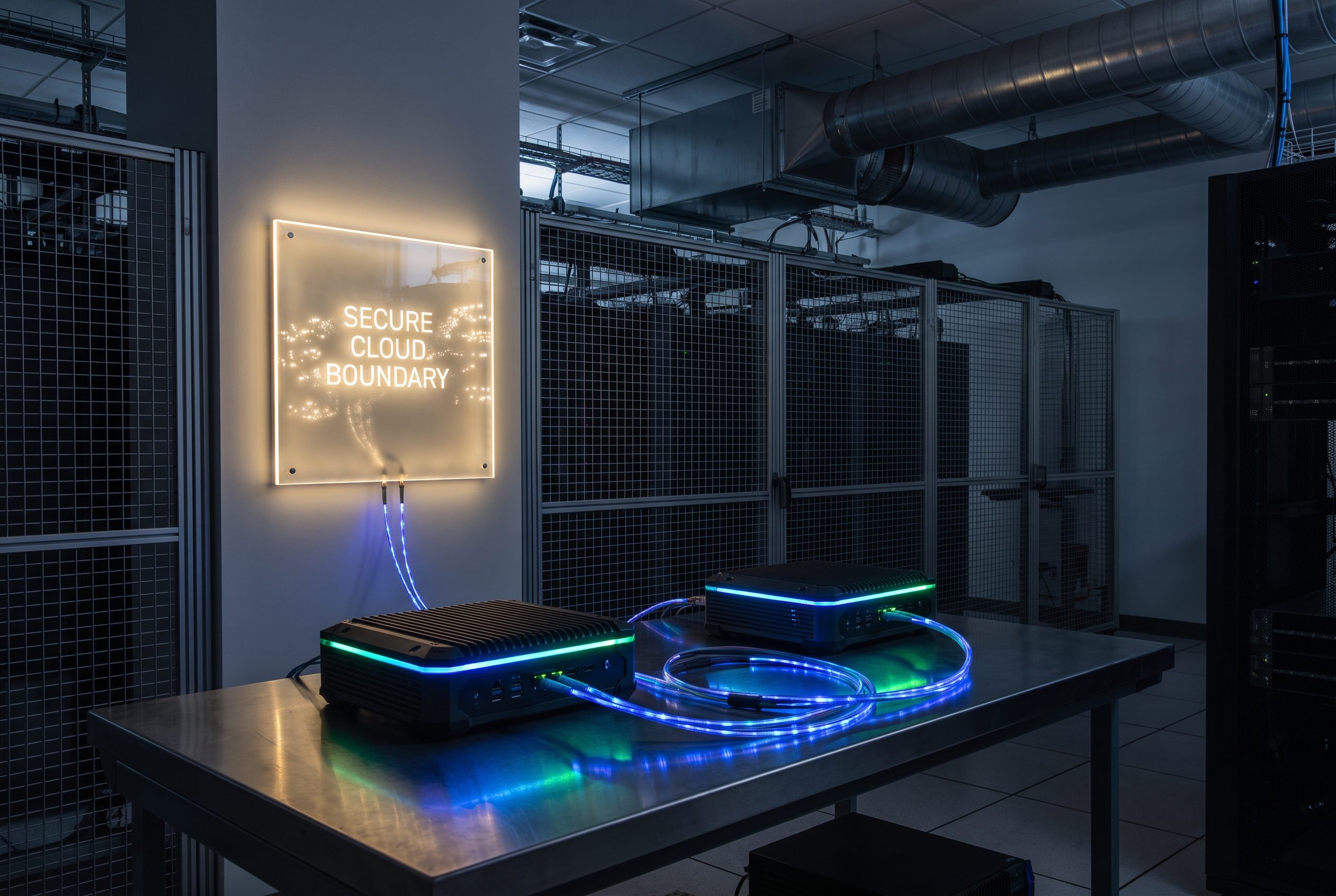
This is hybrid inference, not cloud replacement. NVIDIA describes Perplexity Portable Computer as a local workflow that can selectively escalate work to more than 15 cloud models, with permission before content leaves the device. The model is sensible for teams handling source code, financial records, or customer documents: local by default, remote when the expected quality gain justifies the transfer.
How developers and infrastructure teams should evaluate it
Start with one narrow workflow, not a general claim that an agent runs locally. Use representative documents, realistic tool calls, and the context length the service actually sees. Include bad inputs: a scanned PDF, a stale repository, a request with conflicting instructions, and an offline period.
| Measure | Why it matters | Practical test |
|---|---|---|
| Time to first token | Shows interactive responsiveness | Record p50 and p95 after cold and warm starts |
| Task completion time | Captures tools, retrieval, and retries | Run a fixed 20-task suite end to end |
| Context fit | Exposes memory pressure before production | Increase documents until quality or latency degrades |
| Cloud handoff rate | Shows whether local routing is earning its place | Log the policy reason for every escalation |
| Recovery behavior | Prevents a desk-side outage from stopping work | Disconnect a node and verify queued work moves safely |
Keep observability local as well. Store a trace ID, selected model, quantization, context size, input classification, tool latency, and handoff reason for each task. Without that data, a hybrid deployment becomes a collection of anecdotes. With it, an infrastructure team can find whether the actual bottleneck is prefill, a database query, an unavailable workstation, or a model that needs a larger remote fallback.
A practical rollout for local agents
- Choose a workflow where privacy, intermittent connectivity, or short interactive loops create a clear reason to run locally.
- Set a data egress policy before selecting models. Define what can leave the device, who approves it, and how the event is recorded.
- Pin runtime and model versions. Test updates against a known evaluation suite before rolling them to every workstation.
- Put local nodes behind health checks. A router needs capacity and availability signals, not just a list of IP addresses.
- Define a cloud fallback with a user-visible rule for sensitive requests. Failure should degrade predictably, not silently spill private context.
The next local AI deployment will be judged less by whether it can load a huge model and more by whether it completes a real workflow safely. RTX Spark, faster open runtimes, and local routing make that test more practical. The teams that benefit will treat the desk-side machine as part of an inference system with policy, telemetry, and a measured cloud escape hatch. Run and scale models with Wiro.
Technical references: NVIDIA IFA 2026 local AI announcement; NVIDIA DGX Spark hardware guide; NVIDIA DGX Spark product overview.