Video captioning infrastructure is moving closer to the media pipeline itself. Once a team publishes a few clips a week, captions can stay inside an editor. At hundreds or thousands of clips, the job becomes inference, validation, rendering, storage, and delivery. The Wiro Video Caption model accepts a source clip and can return speech-timed captions or a fixed text treatment. That turns a last-mile accessibility task into a production system with queues, failure modes, and service-level targets.
Why video captioning infrastructure became a pipeline problem
Captioning has two different outputs. A sidecar file such as WebVTT or SRT carries text and timestamps separately from the video. A burned-in output renders glyphs into every frame. The first is flexible and searchable. The second gives social teams a consistent look, but it creates a new video derivative for every style, language, or correction. A spelling fix can therefore become another render job rather than a text edit.
Speech recognition also does not finish the work. The original Whisper research describes a model trained on 680,000 hours of multilingual, multitask supervision. It can transcribe, translate, identify language, and handle speech-related tasks from one model family. That is useful capability, not a guarantee of production-ready captions. A platform still has to decide where to cut lines, how long each line stays visible, where captions sit on a vertical frame, and what happens when audio is absent, clipped, or contains two speakers.
The throughput pressure rises with generated video. A team that renders 60-second clips for five channels may need horizontal, square, and vertical derivatives. Add revisions, localization, and brand templates, and one source clip can produce dozens of assets. The right question becomes: can the system turn media into reviewed, versioned captioned outputs without making editors wait on a manual queue?
What a captioning pipeline actually does
A dependable job starts before inference. Validate the container, codec, duration, audio stream, loudness, frame rate, and dimensions at ingest. MP4, MOV, MKV, and M4V can all carry video, but a file extension does not prove that an audio stream is usable. Rejecting or routing a silent clip before a GPU worker touches it is cheaper than discovering the problem after rendering.
Next, create a canonical audio representation. Most automatic speech recognition systems work best with predictable sample rates and channel layouts. Keep that normalized audio and the original media under the same job ID. It makes retries reproducible and lets a reviewer inspect what the recognizer heard rather than what an editor remembers uploading.
Inference produces segments, confidence signals when available, and timestamps. Do not treat those timestamps as final typography. A useful caption renderer imposes policy: maximum characters per line, maximum lines, minimum on-screen dwell time, safe margins, contrast, and placement. A 9:16 clip needs a different safe zone from a 16:9 tutorial. Platform controls can cover subtitles, UI chrome, or the presenter if a template is reused blindly.
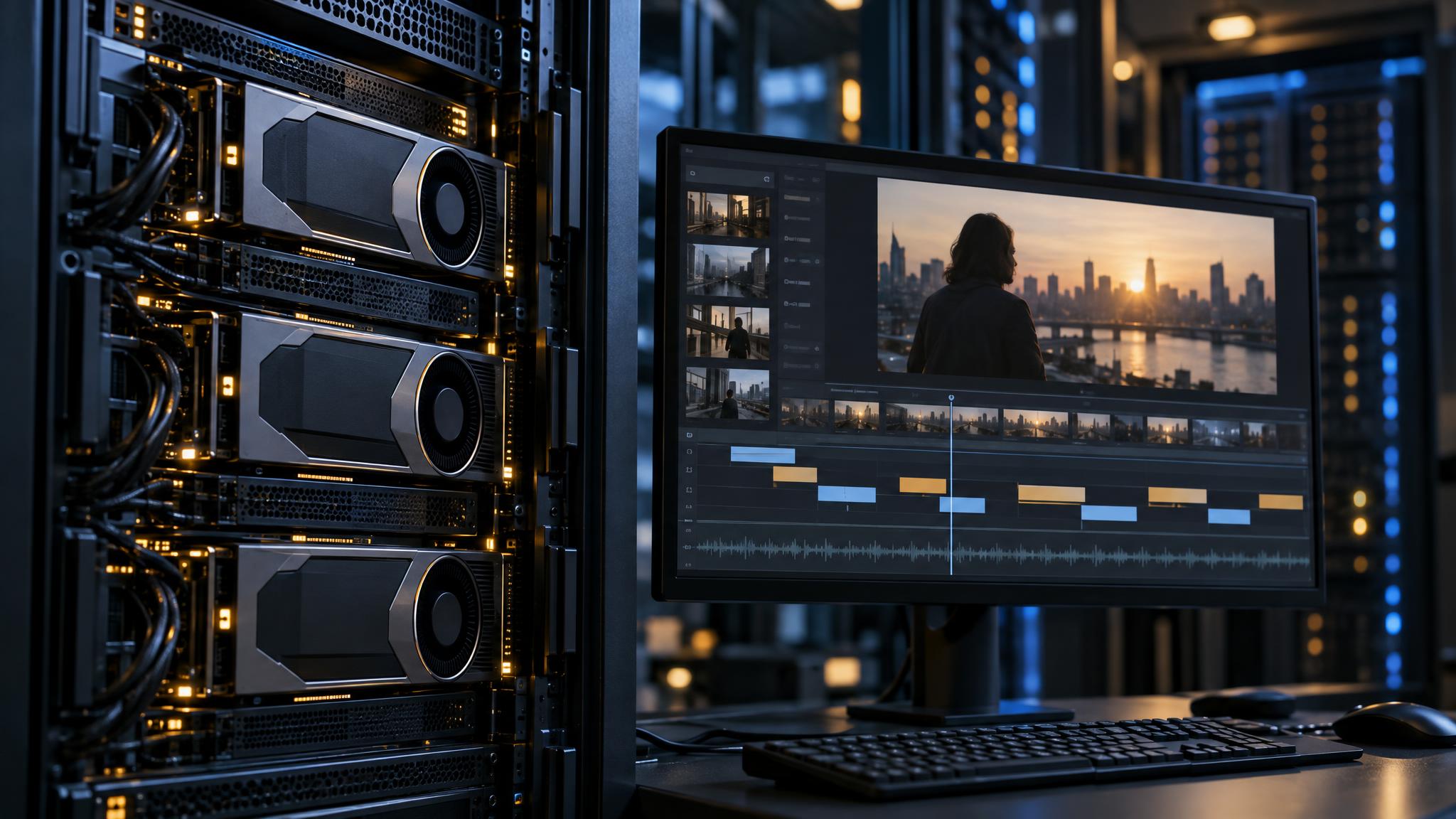
Then render. For burned-in captions, the renderer must decode frames, composite styled text at the right time, encode a new video, and write it to durable storage. That work competes with other video jobs for GPU decode, CPU encode, I/O bandwidth, and egress. Keep the clean source. Store each captioned derivative with its source ID, transcript version, template version, language, and renderer version. Those fields turn a vague support ticket into a query.
Capacity, latency, and GPU trade-offs
GPU utilization is only one capacity number. Queue delay, audio duration, batching policy, video resolution, and encoding speed all change the user-visible completion time. A short clip can spend longer waiting for a worker than being transcribed. Long clips create the opposite risk: one large job can occupy a worker while dozens of quick social exports wait behind it.
Published benchmarks show why batching needs deliberate limits. The faster-whisper project reports a 13-minute audio benchmark on a GPU: its large-v2 FP16 run with batch size 8 took 17 seconds and used 6,090 MB of VRAM. The unbatched FP16 run took 63 seconds and used 4,525 MB. Those are benchmark results, not a sizing promise. They still show the trade: batching can improve throughput while increasing memory demand. A team that batches aggressively can turn an audio service into an out-of-memory incident when concurrent requests arrive.
Use separate queues for interactive and bulk work. Give an editor retrying a 30-second clip a latency budget. Send back-catalog transcription or multi-language exports to a throughput queue. Cap input duration and resolution per class. Record real-time factor, queue time, GPU memory peaks, failure rate, and output size. These metrics show whether the bottleneck sits in ASR, rendering, storage, or delivery.
Autoscaling should follow the slowest stage, not a single generic CPU number. A transcription worker may need GPU memory. A burn-in worker may hit encoder capacity or local disk first. If those stages share a pool, a spike in one can starve the other. Splitting the stages also makes it easier to rerun only the failed part after a temporary storage or encode error.
Quality controls that catch expensive mistakes
Caption quality has a language layer and a layout layer. Sample both. Test noisy rooms, music beds, acronyms, fast speakers, overlapping speakers, code-switching, and names unique to the business. Compare the transcript to a human reference on a fixed evaluation set. Track word error rate if a reference exists, but also track the errors a viewer sees: missing negation, wrong names, captions hidden behind UI, and unreadable line breaks.
Timing deserves its own check. A word-level timestamp can be technically aligned yet uncomfortable to read. Captions should neither flash for a fraction of a second nor lag behind the speaker. Render a few representative frames from every new template at each target aspect ratio. This catches unsafe lower-third placement before a batch produces hundreds of unusable files.
Make review risk-based. Route low-confidence speech, detected overlap, missing audio, and unusual duration to a human. Let ordinary, high-confidence jobs pass through automatically. That keeps people focused on exceptions instead of watching every clip. The same rule applies to translations: a source transcript that is wrong will not become correct after styling.

A practical deployment pattern for developers
Start with immutable inputs and idempotent jobs. Hash the source asset, then use the hash plus language and template version as a job key. A retry should return the same job rather than create duplicate renders. Send state transitions to a queue: received, validated, normalized, transcribed, rendered, quality-checked, delivered, or failed. Every transition should contain a reason and a correlation ID.
Use sidecar captions as the system of record when the channel supports them. Generate a burned-in derivative only when the distribution channel or creative requirement needs it. That reduces unnecessary encoding and preserves the ability to restyle captions later. It also supports accessibility workflows that need selectable text rather than pixels.
Set retention rules early. Original video, normalized audio, transcripts, rendered outputs, and debug artifacts all have different privacy and cost profiles. Audio may contain personal data. Limit access, encrypt storage, and delete temporary artifacts on a schedule that matches the product promise. A captioning service that cannot explain where a transcript came from will struggle during a customer audit.
For a production baseline, define a small template set, collect a hard evaluation corpus, separate latency-sensitive jobs from bulk work, and instrument each stage. Then run a real model behind the workflow. Video Caption on Wiro provides a useful building block for rendering captioned media, while the surrounding pipeline supplies the validation, observability, and governance that production teams need. More AI infrastructure coverage examines the systems around model calls. Run and scale captioning workloads on Wiro when consistent timing and controlled output matter.
For technical context, see the Whisper research paper and the faster-whisper benchmark documentation.